Triple Solitaire — Turn 3


How to Play Triple Solitaire (Turn 3) — Quick Guide
Goal
Sort all cards into twelve foundation piles by suit (three piles per suit). Build up cards in ascending order from A to K. For example, a 6 can be placed on a 5 .
Tableau Columns
Arrange cards in the 13 columns in descending order, alternating colors. For example, a J can be placed on a Q or Q.
Moving Cards
Move cards individually or in pre-sorted groups that follow the rules.
Empty Columns
Only a K can start a new column.
Stockpile and Waste Pile
Click the stockpile to flip 3 cards to the waste. The top waste card is playable.


What is Triple Solitaire (Turn 3)?
Unlike the classic version, Triple Solitaire forces you to juggle three streams of cards at once. It’s like conducting an orchestra — you have to keep track of the rhythm of each deck, find harmony between them, and adjust your strategy on the fly if one starts to fall out of sync.
Historically, Solitaire has been a single-player game. You’re not competing against a cunning opponent, but against the very structure of the game: its scale, its limited visibility, and the need to keep hundreds of possibilities in mind. Victory depends not on luck, but on your ability to find order in seeming chaos, where every card can be the key to success.
This format is perfect for those looking for a game of reflection. You learn to sacrifice short-term gains for long-term strategies, and every mistake becomes a lesson, not a defeat. Triple Solitaire isn’t just cards on a screen. It’s a workout for your brain, where every game leaves you feeling like you’ve completed an intellectual marathon.
Triple Solitaire (Turn 3) Rules — Step-by-Step
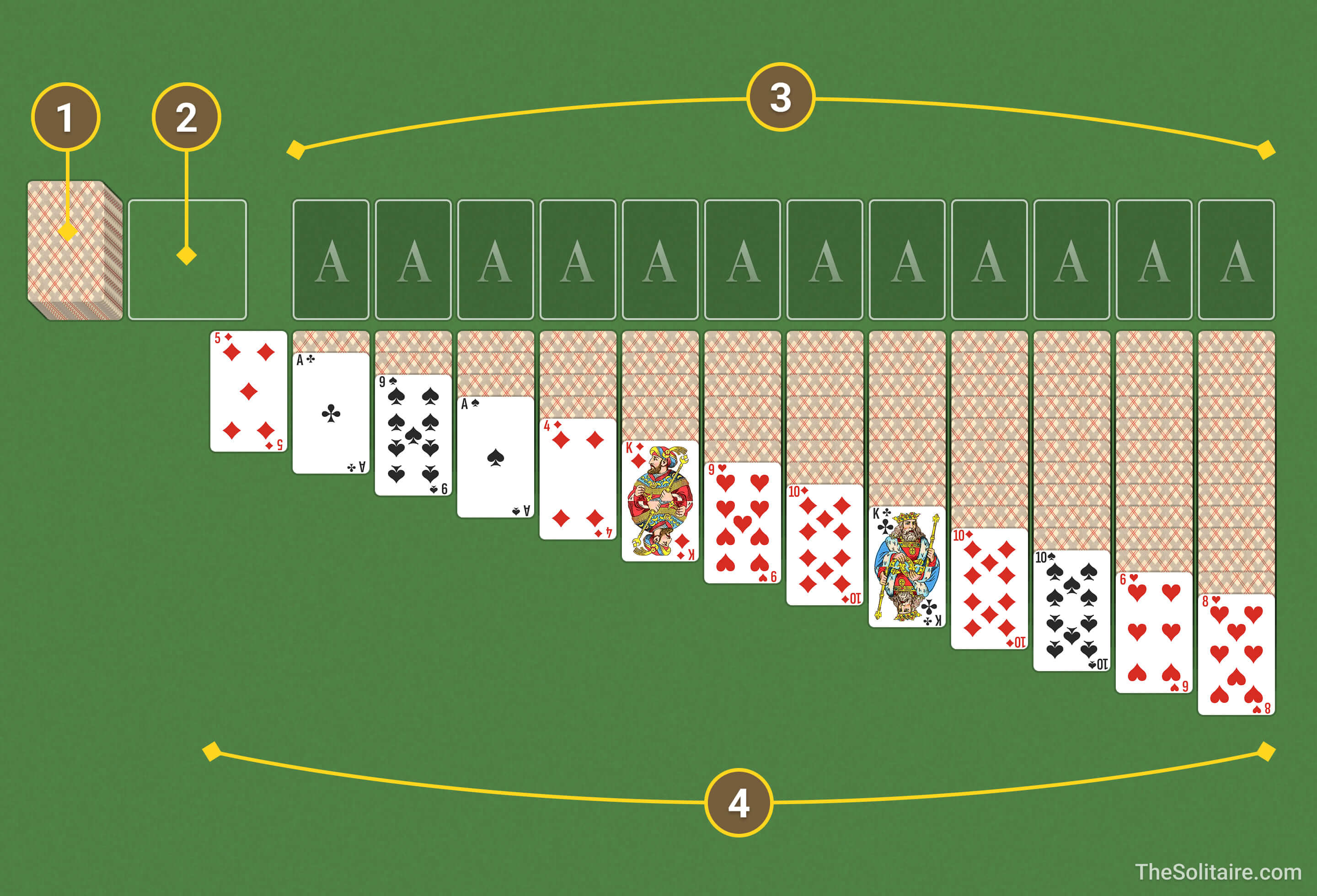
Triple Solitaire (Turn 3) uses 3 standard decks of 52 cards (156 cards total).
Piles and layout
- Contains 65 cards.
- Click the stockpile to flip the top 3 cards to the waste pile.
- Holds cards flipped from the stockpile.
- Only the top card is available for play.
- Goal: Build up all cards into 12 foundation piles by suit, 3 piles per suit.
- Start with an A, then add cards sequentially: 2, 3, ..., K.
- 13 columns of cards: 1st column — 1 card. 2nd column — 2 cards, …, 13th column — 13 cards.
- The topmost card of each column is face up. All other cards are face down.
- Build down in descending order, alternating colors. For example: Q, J, 10.
How to Move Cards in Triple Solitaire (Turn 3)
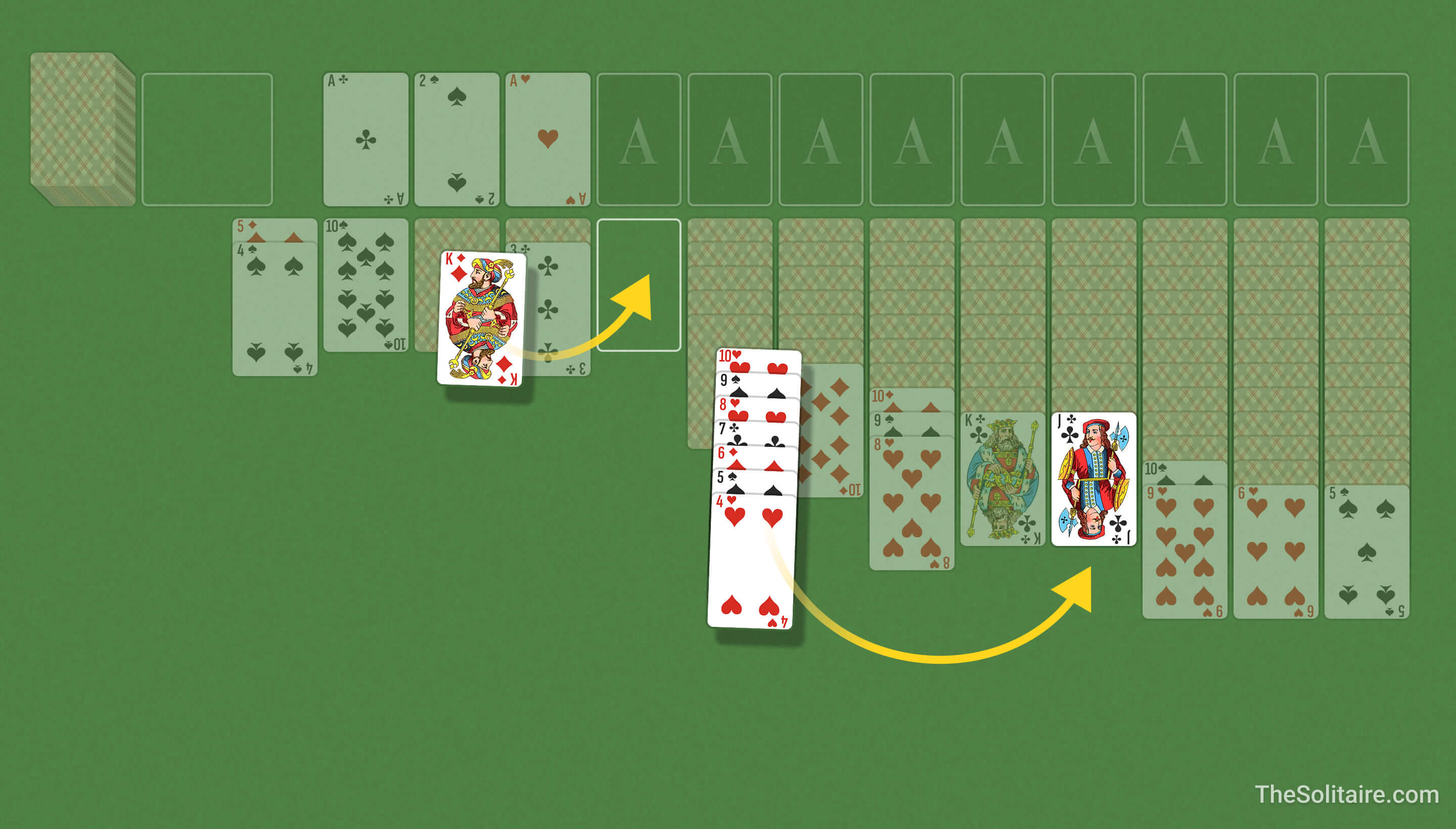
- Cards can only be placed in descending order (J, 10, 9, etc.).
- Alternate suit colors. Example: A J can be placed on a Q or Q.
- You can move individual cards or pre-sorted groups that follow the rules.
- Only a K can start a new column.
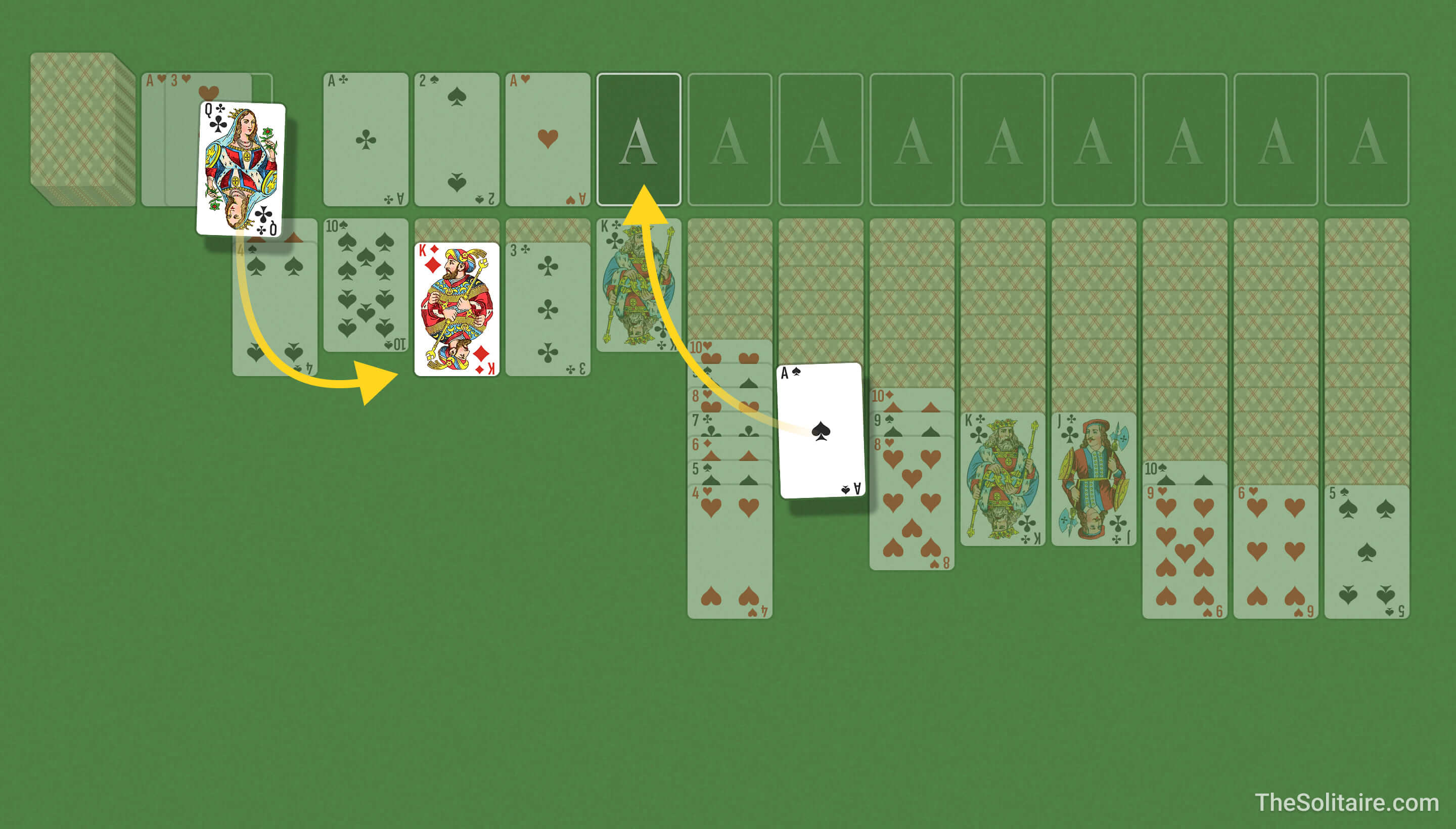
- Start with an A and build up in ascending order within the same suit. Example: A, 2, 3.
- You can move a card from the foundation back to the tableau if needed.
- Click the stockpile to flip 3 cards to the waste pile.
- The top card of the waste pile can be moved to the tableau or foundations.
- Customize the number of passes through the stockpile and difficulty:
- 1 pass: challenging;
- 3 passes: classic;
- unlimited passes: relaxed play.
Keyboard Shortcuts
 Navigate
 Take/Place Card
 Undo
Undo
 Use Deck
 Hint
Hint
 Pause Game

Triple Solitaire (Turn 3) Strategies — Tips & Tricks
A few insider secrets from seasoned Solitaire players to help you win more often.
- Aces and Deuces. Move A and 2 to foundations as soon as they’re revealed. In Triple Solitaire, it's more risky to block columns with low cards because there are more cards to manage, and space is limited.
- Balance your progress. Avoid letting one suit get ahead. If you’ve built up to 10 but are stuck at 3, you risk hitting a dead end. Keep weaker suits in check, even if it slows you down.
- Take advantage of all three decks. Don’t get stuck on one solution — if a combination doesn’t work, you’ll probably have a chance to make a similar one with copies of the same cards.
- Kings: mind the colors. Don’t fill empty columns with Kings of the same color. If you already have 3 red Kings () and no black ones (), skip placing another red King. It’s better to wait for a black King than to lock the game.
- Use deck passes strategically. Each time you pass through the deck, new cards become visible. When you take a card from the current trio, it shifts the order of the remaining cards: those hidden underneath will become accessible in future passes. This allows you to control the layout and gradually bring the cards you need to the top.
More Big Solitaire Games
Triple Solitaire is a big-table game with more cards and a larger layout. If you enjoy larger games on a big screen, try Lincoln Greens, Double FreeCell, and Double Pyramid. Lincoln Greens uses 4 decks, Double FreeCell adds extra free cells and more cards to manage, and Double Pyramid uses two decks.