Triple Solitaire (Face Up)


How to Play Triple Solitaire (Face Up) (Turn 1) — Quick Guide
Goal
Sort all cards into twelve foundation piles by suit (three piles per suit). Build up cards in ascending order from A to K. For example, a 6 can be placed on a 5 .
Tableau Columns
Arrange cards in the 13 columns in descending order, alternating colors. For example, a J can be placed on a Q or Q.
Moving Cards
Move cards individually or in pre-sorted groups that follow the rules.
Empty Columns
Only a K can start a new column.
Stockpile and Waste Pile
Click the stockpile to flip cards to the waste pile one by one.
The top waste card is playable.


What is Triple Solitaire (Face Up) (Turn 1)?
Triple Open Solitaire is a quiet yet profound game for those who love cards without the rush or mystery. With three decks and all cards face up from the start, there’s no guessing, only planning. Quiet focus replaces adrenaline, because you can see the full layout from the beginning. Every move becomes a deliberate step, and victory comes through analysis, not luck.
The game’s roots lie in classic Klondike Solitaire, but it has evolved into something new in the digital age. With three decks, you don’t just get more cards, you get new layers of strategy. Because all cards are face up, you see the entire layout at once, like a puzzle in your hands, and your task is to solve it by exploring the possibilities. There are no opponents here, just you and your ability to find connections between suits and numbers.
This is a game for those who value calm and clarity. There’s no rushing. You move cards in sync with your thoughts, like having a dialogue with the layout. In Triple Solitaire, there are no hidden cards, so you don’t need quick decisions. Instead, it offers what is often lacking in everyday life: time to think, to see patterns, and to feel the chaos of the cards turn into order.
Triple Solitaire (Face Up) (Turn 1) Rules — Step-by-Step
Triple Solitaire (Face Up) (Turn 1) uses 3 standard decks of 52 cards (156 cards total).
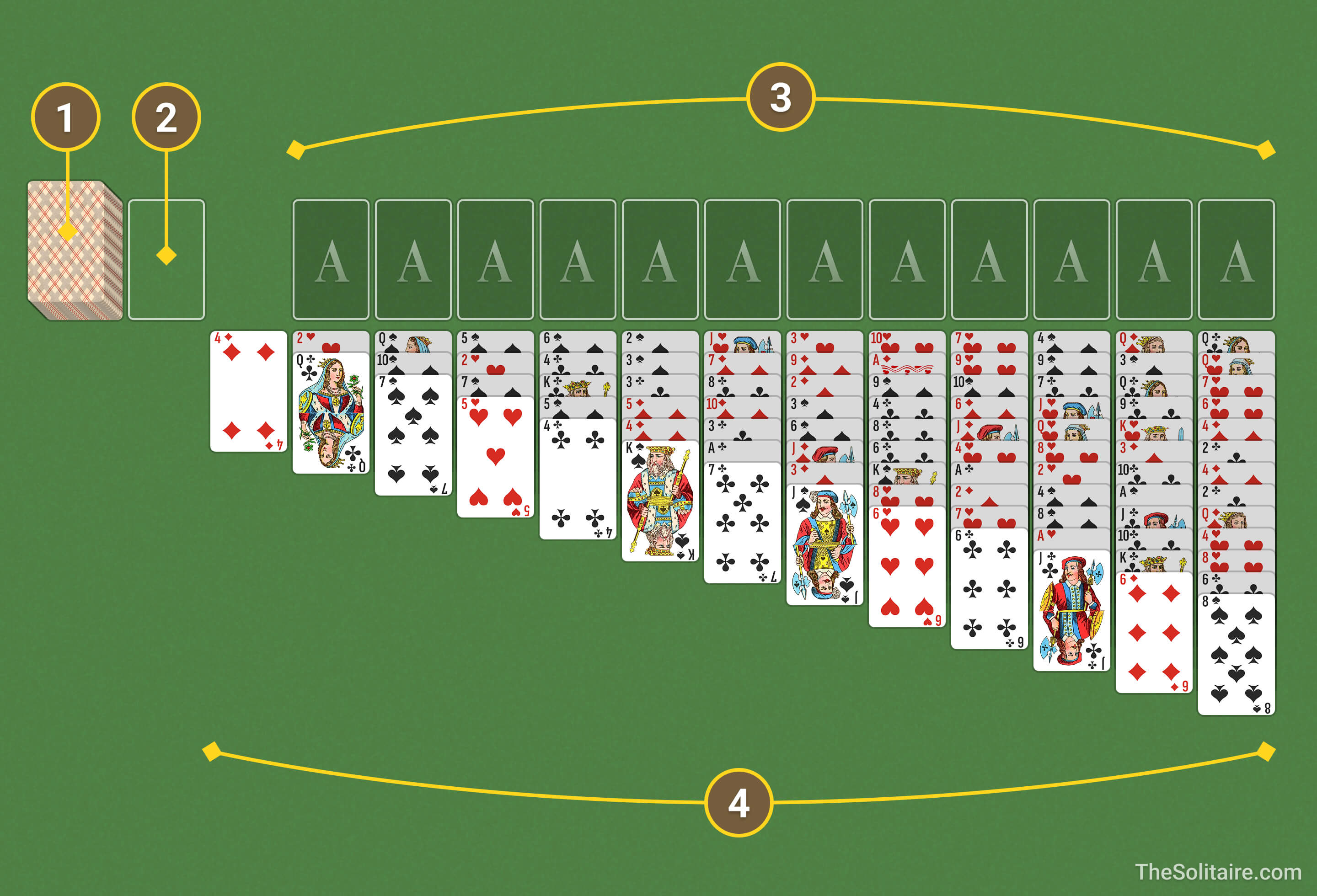
Piles and layout
- Contains 65 cards.
- Click on the stockpile to flip the top card one at a time to the waste pile.
- Holds cards flipped from the stockpile.
- Only the top card is available for play.
- Goal: Build up all cards into 12 foundation piles by suit, 3 piles per suit.
- Start with an A, then add cards sequentially: 2, 3, ..., K.
- 13 columns of cards: 1st column — 1 card. 2nd column — 2 cards, …, 13th column — 13 cards.
- The topmost card of each column is face up. All other cards are face down.
- Build down in descending order, alternating colors. For example: Q, J, 10.
How to Move Cards in Triple Solitaire (Face Up) (Turn 1)
- Cards can only be placed in descending order (J, 10, 9, etc.).
- Alternate suit colors. Example: A J can be placed on a Q or Q.
- You can move individual cards or pre-sorted groups that follow the rules.
- Only a K can start a new column.
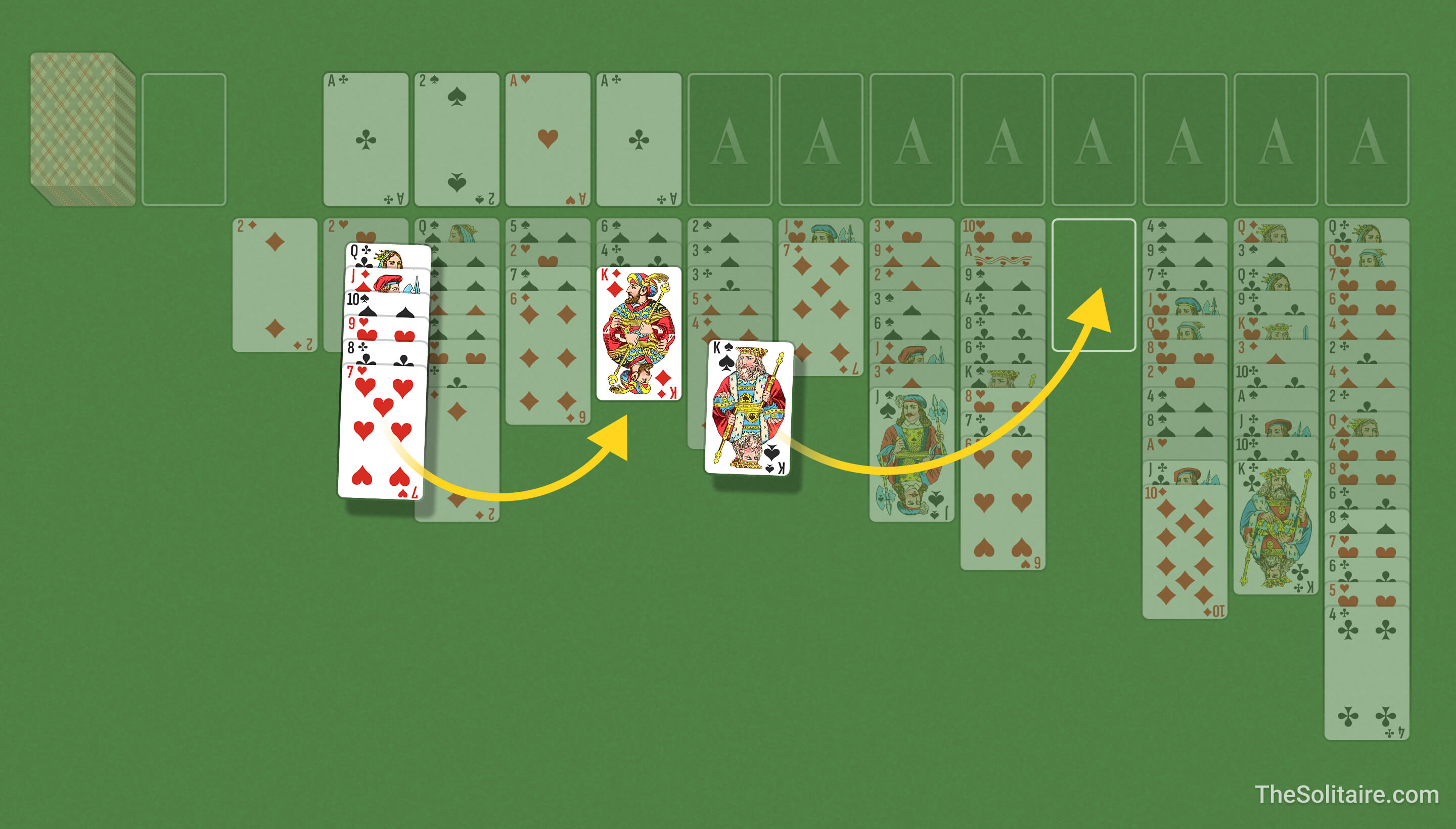
- Start with an A and build up in ascending order within the same suit. Example: A, 2, 3.
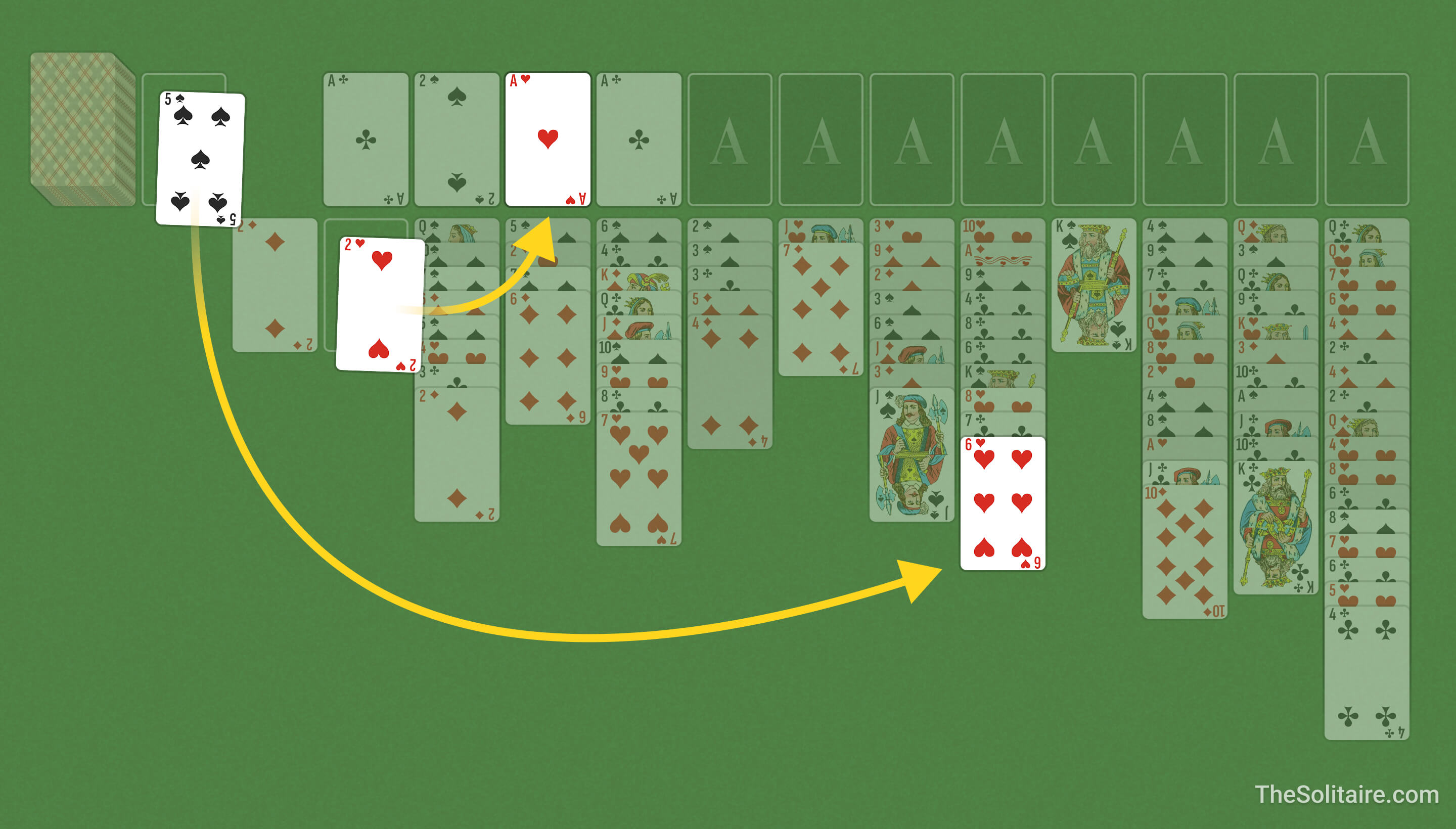
- You can move a card from the foundation back to the tableau if needed.
- Click the stockpile to flip cards to the waste pile one at a time.
- The top card of the waste pile can be moved to the tableau or foundations.
- Customize the number of passes through the stockpile and difficulty:
- 1 pass: challenging;
- 3 passes: classic;
- unlimited passes: relaxed play.

Triple Solitaire (Face Up) (Turn 1) Strategies — Tips & Tricks
A few insider secrets from seasoned Solitaire players to help you win more often.
- Plan like a chess player. All the cards are visible, so use that to your advantage. Don’t make random moves. think several steps ahead and plan each action carefully. Before you move anything, visualize how the layout will change once you make your moves.
- Foundations. You can return cards from the foundations to the tableau. But to do this, you’ll have to remove all the cards on top of them first. Just make sure there’s enough space in the columns to temporarily place these cards before you start.
- Kings: mind the colors. Don’t fill empty columns with Kings of the same color. If you already have 3 red Kings () and no black ones (), skip placing another red King. It’s better to wait for a black King than to lock the game.
- Don’t hesitate to use a hint. Click the
 button to see possible moves. In this version of Solitaire, where all cards are face up, the amount of information can be overwhelming. The hint will help you to avoid missing important moves that are easily overlooked among the many cards. Using it is not a sign of weakness—it’s a smart move, especially when you’re stuck or want to make sure you haven’t missed anything.
 - Feel free to experiment! If you change your mind or mess up, hit the
 Undo button to put the cards back where they belong. Try different options — you can always find your way out of a dead end.
More Big Face-Up Solitaire Games
Triple Face Up Solitaire is played on a large tableau, with every card visible from the first move. If you like open games with lots of space, try Double Pyramid, Lincoln Greens, and Double FreeCell. Double Pyramid uses two decks, and you clear cards by removing pairs that add up to 13. Lincoln Greens is the biggest Golf Solitaire variant on our site, with four decks, a wide layout, and plenty of cards in play. Double FreeCell is dealt face up and adds extra free cells to park cards.