Many players approach Solitaire as a game of pure chance, flipping cards and hoping for the best. Through thousands of games played on TheSolitaire.com, we’ve identified specific strategies that consistently improve win rates. While luck plays a role in which cards appear, your decisions determine whether you win the winnable games — and that’s where real improvement happens.
Understand the Basics Of Solitaire
Before diving into advanced techniques, let’s establish the fundamentals. In Klondike Solitaire, you work with three main areas: the tableau (seven columns of cards), the foundation (four piles where you build suits), and the stock/waste pile (your draw deck).
The goal is straightforward: build four foundation piles, one for each suit, starting with Aces and ending with Kings in ascending order. Cards in the tableau must be arranged in descending order with alternating colors. You win when all 52 cards are successfully moved to the foundation piles. Understanding when to move cards between these areas — and when to wait — forms the core of winning play.
Uncover Cards First To Increase Your Win Rate
The single most important principle comes down to information. Every face-down card represents an unknown variable that limits your ability to plan ahead. Consider this: if you have a black 8 available but don’t know what’s under the next face-down card, you might build on the 8 and block access to a red 7 you desperately need later.
Reveal Larger Tableau Stacks
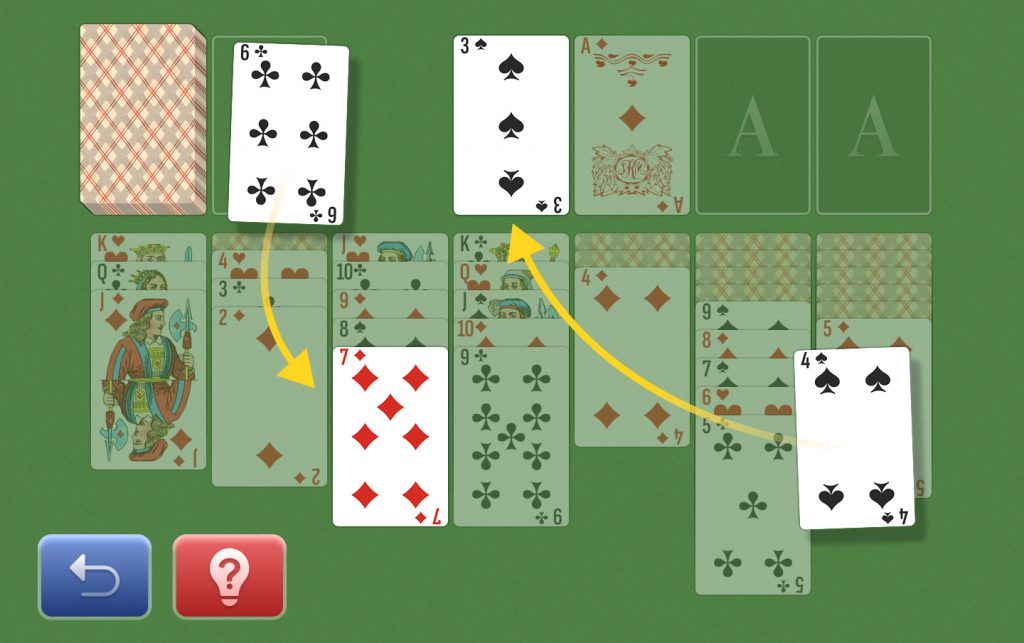
When multiple moves seem equally good, prioritize columns with more face-down cards. If you can move a 6 to reveal one card or move a 9 to reveal three cards, choose the 9 even if the 6 move looks cleaner.
Here’s a practical example: you have a red 5 that could go on either a black 6 in column two (which has one face-down card beneath) or a black 6 in column five (which has four face-down cards). Always choose column five. Those three extra reveals might contain the King you need or expose a card sequence that unlocks your entire game. Players who ignore large stacks often find themselves stuck with no moves while hidden cards could have saved them.
Move Cards To Expose Face-Down Cards
Sometimes the best move isn’t the obvious one. If moving a Jack between columns doesn’t reveal anything new, but moving a 7 reveals a face-down card, prioritize the 7. Each revealed card gives you more information to work with and potentially opens new pathways. This principle should guide nearly every tableau decision in the early and middle game.
Master Safe vs. Critical Foundation Moves
Not every foundation move helps your cause. This concept surprises many players, but moving cards to foundations too aggressively is one of the fastest ways to lose winnable games.
Push Aces and Twos Immediately
Low cards — Aces, Twos, and typically Threes — can safely go to foundations without hesitation. These cards won’t block any tableau building since nothing can be placed on an Ace or Two. Moving them up clears tableau space and simplifies your board without creating problems.
Delay Mid-Rank Cards If Needed
Here’s where strategy becomes nuanced. Imagine you have a 7 of Hearts in your tableau, and the foundation already has the 6 of Hearts. The obvious move is pushing that 7 up. But what if you need that 7 to place a black 6 on it, which would then let you move a 5 and reveal a critical face-down card?
Mid-rank cards (particularly 6 through 9) often work harder in the tableau than in foundations. Ask yourself: “Do I need this card for building right now?” If the answer is yes or maybe, leave it in play. You can always move it to foundations later, but you can’t bring it back down. This single principle can add 10-15 percentage points to your win rate once you master it.
Manage The Tableau For Fewer Blocked Cards
Watch experienced players and you’ll notice something interesting: their tableaus look balanced. Beginners often create one or two very long columns while leaving others nearly empty.
Spread Out Moves Across Different Columns
Building one tall sequence feels satisfying, but it’s strategically poor. When you concentrate all your moves in two columns, you reduce your options dramatically. If you need to place a red 9 and only have one black 10 available (buried under six cards in your mega-column), you’re stuck.
Instead, distribute moves across all seven columns. Keep them roughly even in height. This gives you multiple building options and prevents the common situation where you have cards but nowhere to play them. Think of it like keeping multiple doors open instead of building one massive door while boarding up the others.
Create Empty Spaces Wisely
Empty columns are the most valuable resource in Solitaire, but only when used correctly. New players create empty columns by accident and immediately fill them with whatever King appears. This wastes the opportunity.
An empty column lets you move an entire sequence at once — a powerful maneuver. If you have a King-through-8 sequence in one column blocking an important card, an empty space lets you temporarily relocate that entire stack. Plan your empty columns deliberately. Clear a column only when you can see how that empty space will help you access buried cards or reorganize problematic sequences.
Prioritize Kings and Empty Columns Strategically
King placement might seem simple — they’re the only cards that fill empty columns — but choosing which King matters significantly.
Choose the Right King For Each Opening
When you have multiple Kings available, evaluate each option. A King of Spades with a Queen of Hearts on it is very different from a bare King of Diamonds. The King-Queen combination already starts a sequence, giving you an immediate building option. The bare King needs another card before it becomes useful.
Also consider color balance. If your tableau is heavy on red cards, placing a black King creates more building opportunities. Whether you’re playing Solitaire with one card face up or Turn 3 face up, this principle remains the same. Look at what you need, not just what’s available.
Avoid Leaving Columns Empty Too Soon
Creating an empty column in move 15 of a game sounds good until you realize no Kings are available for the next 30 cards. That empty column becomes a wasted resource — dead space that could have held useful building sequences.
Time your empty columns to coincide with King availability or clear strategic need. If you’re cycling through the stock and know a King is coming soon, then clearing a column makes sense. Otherwise, keep columns working until the right moment arrives.
Optimize Stock and Waste Cycling
The stock pile follows a fixed order. This isn’t random luck — it’s a predictable sequence you can learn to work with.
Plan One Cycle Ahead
As cards appear in the waste pile, note the important ones. When you see the King of Clubs on your first pass through the deck, remember it’s coming. If you create an empty column just before cycling through again, you’ll have that King ready to place.
This memory technique separates intermediate from advanced players. You don’t need to remember every card, just the high-value ones: Kings, useful building cards, and cards blocking important sequences. After a few hundred games, this pattern recognition becomes automatic.
Skip Moves To Realign The Deck
Here’s an advanced technique that feels wrong at first: sometimes you should skip an available move to change the stock cycle alignment. If making a move now means you’ll miss a critical card in the waste pile on the next cycle, passing might be better.
This requires experience to execute well. Start by recognizing when you’re close to cycling through and a key card is about to appear. If you can delay other moves to sync with that card’s appearance, you create powerful combinations that wouldn’t otherwise be possible.
Use Suit and Color Strategy For Better Stacks
Color alternation is a rule, but how you manage suits within that rule affects your success rate.
Alternate Colors To Keep Options Open
Standard play alternates red and black, which maximizes building flexibility. A red 8 can accept either black 7, doubling your options. This basic principle should guide most of your game, especially in the early and middle stages.
Build Suits Together When Possible
As the game progresses and your tableau opens up, look for opportunities to build same-suit sequences. A Hearts sequence from 10 down to 4 can move to foundations as a group once the 3 of Hearts appears, saving multiple moves.
Here’s when each approach works best:
| Strategy | When to Use | Benefits | Potential Drawbacks |
| Color alternation | Early and middle game | Maximum flexibility | Can create scattered suits |
| Same-suit building | Late game, open tableau | Easier foundation transfers | Reduced building options |
Pay attention to your game state. If you have three empty columns and most cards revealed, same-suit building accelerates your win. If you’re still revealing cards and working with limited space, stick with color alternation for maximum flexibility.
Know How To Win In Timed Solitaire
Timed versions change the calculation. Perfect play that takes three minutes to figure out loses to good-enough play executed in thirty seconds.
In timed games, prioritize moves that reveal cards and avoid deep analysis of foundation timing. When you have three seconds to decide whether to move that 7 up or keep it in the tableau, move it up. The time cost of deliberation exceeds the strategic benefit.
Pattern recognition becomes more important than calculation. After enough games, you’ll instantly recognize that a particular board state requires revealing the column on the right first, or that you need to create an empty space immediately. This intuition only develops through repetitive play.
Make the Most of Undos and Hints
TheSolitaire.com includes undo and hint features, and using them thoughtfully accelerates learning.
Experiment With Different Outcomes
The undo feature lets you test different strategies without restarting. When you face a difficult decision — should you move this 8 to foundations or keep it in the tableau? — try both paths. Play five moves down each path and see which creates better options.
This experimental approach teaches you strategic concepts faster than reading ever could. You’ll discover through direct experience when foundation moves help versus hurt, which builds intuition that applies to future games.
Blend Computer Suggestions With Logic
When you use a hint, pause and ask yourself why the computer suggested that move. The algorithm has calculated several moves ahead and identified that this particular play keeps the most options open. Understanding the reasoning transforms hints from crutches into teaching tools.
After a few dozen games where you analyze hint suggestions instead of blindly following them, you’ll start recognizing similar patterns without needing hints at all.
Can You Win Every Solitaire Game?
Let’s be direct: no, you cannot win every Solitaire game. The mathematics of card distribution mean some deals are unsolvable no matter how perfectly you play. The exact percentage of winnable games depends on the rules variation you’re playing, but even under the most generous rules, some deals are impossible.
What you can do is win every winnable game. That’s the real goal. Beginners might win 15% of their games. Intermediate players win 40-50%. Advanced players with strong strategy can win 70-80% of games, approaching the theoretical maximum winnability.
Your improvement focus should be identifying which games are winnable and executing the correct strategy to win them. The difference between a 40% win rate and a 70% win rate isn’t luck — it’s strategic decision-making.
Tips For Scoring and Tracking Progress
Measuring improvement helps you identify what’s working and what needs adjustment.
Aim For A Good Solitaire Score
Scoring systems vary, but most combine time and moves. A good score in standard Klondike might be:
- Time-based: Under 3 minutes for a win
- Move-based: 90-120 moves for a complete game
- Combined scoring: This depends on the specific implementation, but finishing games efficiently with minimal moves and reasonable speed produces top scores
Don’t obsess over score early in your learning. Win rate matters more than speed or move count when you’re building fundamental skills.
Record Moves and Times For Improvement
Track 20-30 games and look for patterns. Do you lose more games where you moved multiple mid-rank cards to foundations early? Are you consistently getting stuck with the same tableau configurations? These patterns reveal which strategies you need to refine.
After a month of deliberate practice, review your win rate. Improvement should be steady and measurable. If you’re not seeing progress, focus on the first principle: revealing cards before building foundations.
Your Next Move For Winning Solitaire
These strategies represent years of gameplay distilled into actionable principles. Start with the fundamentals — reveal cards first, delay foundation moves for mid-rank cards, and spread your plays across columns. As these become automatic, add the advanced techniques like stock cycling and strategic empty columns.
TheSolitaire.com provides the perfect environment for deliberate practice. The clean interface keeps you focused on decision-making without distractions. The undo feature lets you learn from mistakes immediately. The hint system teaches you to recognize patterns you might otherwise miss.
Set a realistic goal: if you currently win 30% of your games, aim for 45% over the next month. Track your progress. Analyze your losses to identify recurring mistakes. With consistent practice and strategic thinking, you’ll develop the pattern recognition and intuition that define expert play.
FAQs About Winning Solitaire
What Is the Fewest Moves In Solitaire?
The theoretical minimum for completing Klondike Solitaire is 52 moves (one per card), though this is virtually impossible in practice. Realistically, excellent games finish in 60-85 moves. Most winning games take 90-120 moves. Focus on winning consistently before worrying about move count — efficiency comes naturally with experience.
Is There Any Strategy To Solitaire Variants Like Spider?
Yes, Spider Solitaire requires different strategies focusing on creating same-suit sequences and managing empty columns carefully. However, the core principle remains the same: revealing hidden cards takes priority over most other moves. Spider is significantly harder than Klondike, with expert win rates around 50% compared to Klondike’s 70-80%.
How Do I Improve My Timed Solitaire Game?
Focus on pattern recognition over deep analysis. Practice with Solitaire Face Up variations to build recognition of winning patterns, then apply that speed to standard games. The Turn 3 Face Up version helps develop quick decision-making with limited information. Speed comes from seeing patterns instantly rather than calculating each move from scratch. After 200-300 timed games, your recognition speed will naturally increase.