
If you’ve enjoyed classic Solitaire and want a more challenging experience, Spider Solitaire offers the perfect next step. This engaging patience card game requires deeper strategic thinking while maintaining the relaxing, focused gameplay that makes Solitaire so appealing. Whether you’re a curious beginner or looking to refine your skills, understanding what makes Spider Solitaire unique will improve your playing experience.
What Is Spider Solitaire?
Spider Solitaire is a popular patience card game played with two standard 52-card decks (104 cards total). The game gets its name from the eight foundation piles that must be completed to win—similar to a spider’s eight legs. This spider patience card game challenges players to arrange cards in descending sequences from King to Ace within the same suit, then remove these completed sequences from the tableau.
The core objective is straightforward but requires careful planning: build complete sequences of cards in the same suit, running from King down to Ace. Once you complete a sequence, it automatically removes itself from play. Victory comes when you’ve successfully cleared all 104 cards by completing eight full sequences. The spider solitaire game combines elements of strategy, pattern recognition, and patience, making it one of the most intellectually satisfying card games available.
While patience spider solitaire has origins as a card game dating back decades, it became widely popular when included in Microsoft Windows 98. This digital exposure introduced millions of players worldwide to the spider and solitaire connection, establishing it as one of the most-played card games globally. The game’s enduring popularity stems from its perfect balance: simple enough to learn in minutes, yet complex enough to provide years of strategic depth.
How To Set Up The Spider Solitaire Game
Understanding the spider solitaire setup is necessary before you begin play. The layout differs from classic Solitaire, creating unique strategic opportunities. Whether playing with physical cards or online, the setup follows the same principles.
Prepare Two Standard Decks
Spider Solitaire requires two complete 52-card decks combined for a total of 104 cards. When using physical cards, remove any jokers and shuffle both decks together thoroughly — at least seven times for a proper randomization. Some specialty Spider Solitaire decks come with cards numbered identically to help track suits, but standard playing cards work perfectly. When you play spider card game on TheSolitaire.com, the shuffling happens automatically with each new game, guaranteeing a fair and random distribution.
Lay Out Ten Columns
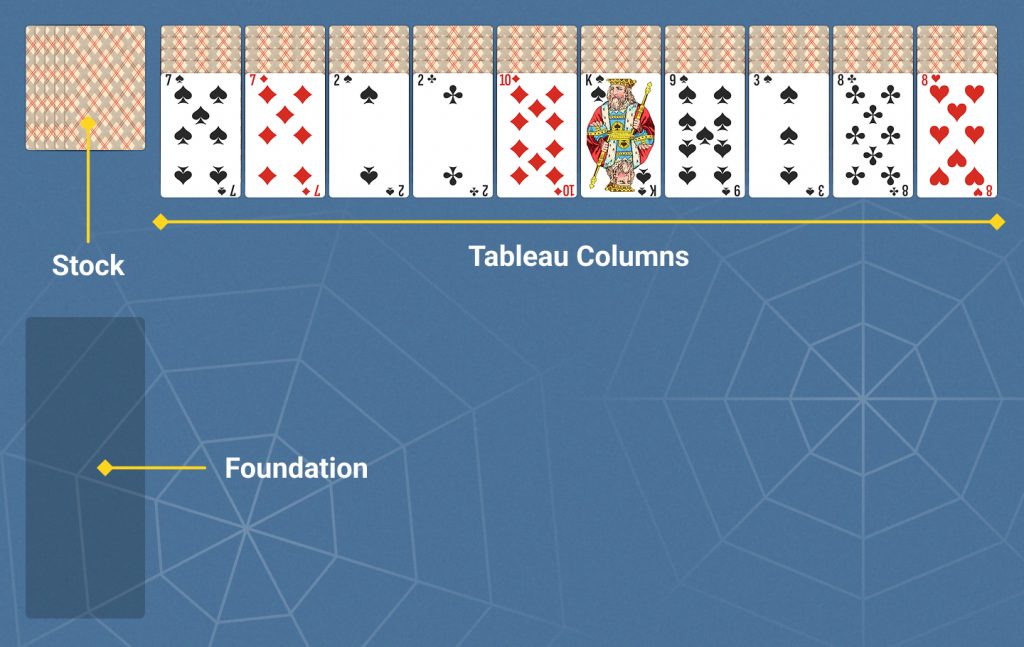
The playing area — called the tableau — consists of ten columns arranged horizontally across the screen or table. These columns hold the dealt cards and serve as the workspace where you’ll build your descending sequences. Unlike Klondike Solitaire’s seven columns, Spider’s ten columns create more maneuvering room but also more complexity. Each column will hold multiple cards stacked vertically, with only the bottom-most (or top-most, depending on your perspective) card of each pile fully visible and playable at the start.
Deal The Initial Cards
The initial deal follows a specific pattern designed to create strategic challenge: the first four columns (from left to right) receive six cards each, while the remaining six columns receive five cards each. Deal all cards face down except for the very last card placed in each column, which should be face up. This creates a staggered layout with exactly 54 cards dealt to the tableau and 50 cards remaining in the stock. The face-up cards represent your starting position — the immediately available cards you can move or build upon.
Keep Remaining Cards As The Stock
The remaining 50 cards form the stock (or draw pile), typically kept to the side or bottom of the playing area. These cards are dealt ten at a time — one to each column — when you choose to deal from the stock. Here’s a rule that catches many new players: you can only deal from the stock when no columns are completely empty. This restriction adds strategic depth, forcing you to think carefully about creating and filling empty spaces. You’ll have five opportunities to deal from the stock during each game (50 cards divided by 10 cards per deal).
Comparison Of One Suit Two Suits and Four Suits
Spider Solitaire offers three distinct difficulty levels that dramatically change the gameplay experience. The spider solitaire one suit version provides an accessible entry point, while spider solitaire 4 suits challenges even experienced players. Choosing the right difficulty level for your skill level makes the difference between an enjoyable challenge and frustrating gameplay.
| Difficulty Level | Number of Suits Used | Typical Win Rate | Best For | Key Challenge |
| One Suit | Spades only | 70-80% with practice | Learning game mechanics | Managing column space efficiently |
| Two Suits | Spades and Hearts | 40-50% for experienced players | Developing advanced strategy | Planning multiple moves ahead |
| Four Suits | All four suits | 20-30% for skilled players | Testing mastery | Creating same-suit sequences amid chaos |
One Suit Spider uses all 104 cards as if they were the same suit — typically displayed as all Spades in digital versions. This means any card can be placed on any card one rank higher without restriction (a 7 of any suit can go on an 8 of any suit). While you still need to create complete King-to-Ace sequences to remove them from play, the lack of suit restrictions dramatically increases your options at every turn. New players can focus on learning the movement patterns, understanding empty column strategy, and grasping the timing of stock deals without the added complexity of suit management.
The spider solitaire 2 variant uses two suits (typically Spades and Hearts) repeated throughout the deck. You can still place cards on any card one rank higher regardless of suit, but only complete sequences of the same suit can be removed from the tableau. This adds a planning layer: that 6 of Hearts might fit on a 7 of Spades now, but it breaks your Spades sequence and might block your progress later. Successful Two Suit play requires looking several moves ahead and sometimes accepting short-term setbacks for long-term gains.
The Four Suit variant represents traditional Spider Solitaire using all four suits as they appear in standard decks. This version presents the most challenging experience because creating same-suit sequences becomes significantly harder. With suits distributed randomly throughout the tableau and stock, you’ll frequently face situations where the card you need is buried under wrong-suited cards. Expert players consider this the “true” Spider Solitaire experience. Many games are unwinnable regardless of skill level, which makes victories particularly satisfying.
Key Moves and Strategy Tips
After playing thousands of games on our platform, we’ve identified the strategies that consistently separate winning players from those who struggle. Mastering spider solitaire strategy transforms the game from a luck-based activity into a skill-driven challenge.
Understanding these fundamental rules helps you develop effective spider sol tricks:
- Cards can be moved to any card one rank higher, regardless of suit (a 5 can be placed on any 6)
- Complete sequences in the same suit from King to Ace are automatically removed
- Empty columns can be filled with any card or in-suit sequence
- A sequence of cards in the same suit can be moved as a unit to any valid destination
- Mixed-suit sequences can only be moved one card at a time
Revealing face-down cards as quickly as possible should be a primary goal. Each revealed card provides new options and information about what lies beneath other columns. Focus on columns with fewer face-down cards first—a column with just one or two hidden cards might reveal game-changing options. Avoid burying long in-suit sequences under other cards when possible. For example, if you have a clean run of 7-6-5-4 of Spades, think twice before placing an 8 of Hearts on top, as this breaks the sequence and makes it harder to move later.
Empty columns function as valuable strategic resources — think of them as temporary storage spaces or maneuvering room. They allow you to reorganize cards, move longer sequences, and create opportunities that wouldn’t otherwise exist. A common strategy: create one empty column early, then use it to shuffle cards between other columns to expose hidden cards. Keep at least one empty column when possible, as it provides flexibility for complex maneuvers. However, be cautious about creating multiple empty columns simultaneously, as this can leave you with few playable cards and force an early stock deal.
While cards can be placed on any higher-ranking card regardless of suit, prioritize creating in-suit sequences whenever possible. Only same-suit sequences from King to Ace can be removed, so building partial same-suit sequences positions you for success. For instance, if you can place a 9 of Spades on either a 10 of Spades or a 10 of Hearts, choosing the Spades maintains your sequence integrity. Sometimes you’ll need to accept out-of-suit placements to expose hidden cards or create empty columns, but always look for opportunities to reorganize cards back into matching suits when the tableau shifts.
One advanced tip from our most successful players: delay dealing from the stock as long as possible. Each stock deal adds ten new cards to your tableau, increasing complexity and potentially burying useful sequences. Exhaust all possible moves in your current tableau before clicking that stock pile. Many players deal too early out of impatience or inability to see remaining moves.
Where To Play Spider Solitaire Free Online
Digital platforms have made spider solitaire online more accessible than ever. Playing Spider Solitaire on TheSolitaire.com provides a clean, distraction-free experience with all three difficulty levels available instantly. Our platform has hosted millions of games, and we’ve designed every feature based on player feedback and observed playing patterns.
The platform offers spider solitaire full screen mode for an immersive experience, along with helpful features like unlimited undo functionality (useful for exploring different move sequences), automatic sequence removal (no manual cleanup needed), and visual hints when you’re stuck. Unlike many platforms that interrupt gameplay with advertisements or require account creation, TheSolitaire.com focuses solely on the playing experience.
Key advantages of playing free spider solitaire online include automatic setup with no need to manually shuffle and deal 104 cards, instant switching between One Suit, Two Suits, and Four Suits difficulty levels, move counting and timing statistics to track your improvement, and the ability to play anywhere on any device with an internet connection. The digital version also prevents illegal moves automatically, helping new players learn the rules through play rather than studying.
TheSolitaire.com offers spider solitaire free to play instantly without downloads, registration, or email requirements. The clean interface keeps you focused on the game itself, providing the calming, distraction-free experience that makes Solitaire games so enjoyable. Our statistics show that players who use the hint feature strategically improve their win rates by 15-20% over time as they internalize the patterns the hints reveal.
Why You Should Try This Spider Game Today
The spider solitaire card game offers remarkable cognitive benefits beyond simple entertainment. Research on patience games suggests that playing regularly improves strategic thinking and planning abilities, as you must consider multiple moves ahead and evaluate trade-offs between different options. The game sharpens pattern recognition skills and provides a calming, focused activity that helps reduce stress while keeping your mind engaged.
Spider Solitaire strikes a perfect balance between luck and skill. While the initial deal determines some outcomes (certain Four Suit deals are mathematically unwinnable), skilled players consistently achieve higher win rates through better decision-making. Our platform data shows that players who complete 50+ games improve their win rates by an average of 25-30% as they develop intuition for move sequences and column management. This makes every game a learning opportunity.
For those ready to deepen their skills, our comprehensive Spider Solitaire strategy guide covers advanced techniques for progressing from beginner to expert level, including specific scenarios, decision trees, and common pitfall avoidance.
Visit TheSolitaire.com to play spider solitaire in a clean, user-friendly environment designed for maximum enjoyment. Start with One Suit to learn the mechanics, then challenge yourself with higher difficulty levels as your skills develop. No registration, no downloads—just pure, focused card game enjoyment whenever you need a mental break or want to sharpen your strategic thinking.
FAQs About Spider Solitaire
What Makes Spider Solitaire Different From Classic Solitaire?
Spider Solitaire differs from Klondike Solitaire in several fundamental ways. Spider uses two decks (104 cards) instead of one, features ten tableau columns instead of seven, and removes completed sequences directly from the tableau rather than building separate foundation piles. The game focuses on building same-suit sequences within the tableau itself, creating a fundamentally different strategic challenge. Spider also allows any card to be placed on any higher-ranked card regardless of suit, whereas Klondike requires alternating colors. These differences make Spider more strategic and less dependent on lucky draws from the stock.
How Long Does a Typical Game Of Spider Solitaire Take To Complete?
Game duration varies based on difficulty level and your playing style. One Suit games typically take 8-15 minutes since they offer more placement options and faster decision-making. Two Suit games average 12-18 minutes as players weigh suit-matching decisions. Four Suit games can extend to 20-30 minutes because each move requires careful consideration of multiple factors. Players who use our platform’s thinking time (pausing between moves) report better win rates but longer game times, while speed players finish faster but win less frequently. The sweet spot appears to be taking 5-10 seconds per move to consider alternatives without overthinking.
Can Spider Solitaire Be Played With Physical Cards?
Spider Solitaire can definitely be played with two physical decks by following the same setup and rules described in this guide. You’ll need a large playing surface — at least 3 feet by 2 feet — to accommodate ten columns comfortably. A dining table or card table works well. Physical play offers advantages: no screen time, tactile card handling, and a meditative quality many players appreciate. The main challenges are tracking which sequences are suit-complete (marking them or using different colored decks helps) and the physical space requirement. Many serious Spider players keep two dedicated decks and play both digital Spider Solitaire and physical games depending on their mood and location.
What Is The Win Rate For Spider Solitaire?
Win rates vary significantly by difficulty level and player skill. Based on our platform data from millions of completed games: One Suit shows 60-70% win rates for beginners and up to 85% for experienced players who play methodically. Two Suits shows 30-40% for intermediate players and 50-60% for advanced players who’ve mastered column management. Four Suits shows 10-20% for casual players and 25-35% for experts who’ve internalized optimal move patterns. These rates assume thoughtful play rather than random moves. Players who consistently review their losing games to understand what went wrong—using our undo feature to explore alternative move sequences — improve significantly faster than those who simply start new games after losses. Our beginner to pro guide includes specific techniques that have helped thousands of players double their win rates within 30 days of focused practice.