Hearts is one of those card games that feels simple in the first five minutes — and then keeps getting deeper the more you play. The goal is the opposite of most trick-taking games: you’re trying to avoid points, not collect them. In practice, it comes down to sharp passing, tracking the penalty cards, and timing your high cards so you don’t get stuck taking a trick with points.
What Is the Hearts Card Game?
Hearts is a trick-taking game from the Whist family (the same family as Bridge and Spades). It’s usually played by four players with a standard 52-card deck, and it’s best known for one thing: keeping your score low.
A quick bit of context: Hearts appeared in the United States around 1880 and likely grew out of older European games like Reversis. In 1909, the Q♠️ was added as a top penalty card (“Black Lady”), which heavily shaped the modern version.
It also became much more widely known through computer versions in the early 1990s (including a Windows 3.11 multiplayer release).
Game objective and Scoring
You win Hearts by finishing the game with the fewest points. Points come only from penalty cards:
- Each ♥️ = 1 point
- Queen of Spades (Q♠️) = 13 points
- Everything else = 0 points
The game ends when any player reaches 100 points or more, and the lowest total wins.
Setup and Passing (How Each Deal Starts)
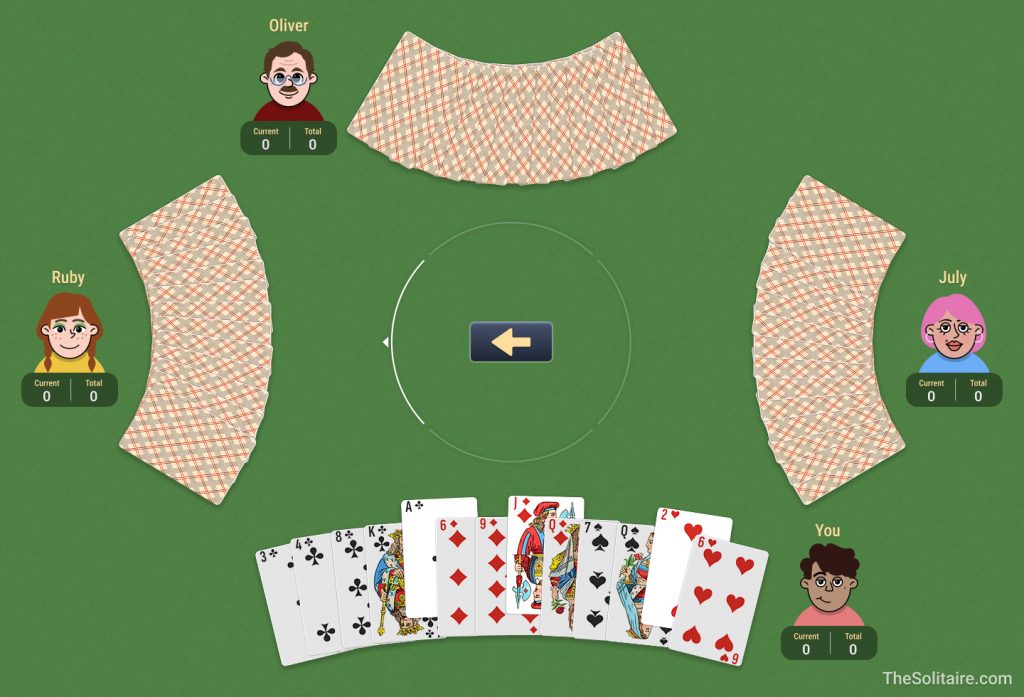
Each deal starts the same way:
- Each player gets 13 cards.
- Everyone chooses 3 cards and passes them. The direction rotates by deal:
- Deal 1: Left
- Deal 2: Right
- Deal 3: Across
- Deal 4: No passing
- Then repeat the pattern.
The pass sets the tone for the whole deal: you try to get rid of trouble cards and keep the ones you can play safely.
Trick Play Rules (Step-by-Step)
1) The first trick starts with 2♣️
The opening lead is always 2♣️.
2) Follow suit if you can
The first card played sets the lead suit. Going clockwise, each player must follow that suit if possible. If you don’t have it, you can play any card.
3) No hearts or Q♠️ on the first trick
On the very first trick, you can’t play a Heart or the Queen of Spades.
4) Highest card in the lead suit wins the trick
Whoever plays the highest card of the lead suit takes the trick — and leads the next one.
5) “Breaking Hearts”
After the first trick, a player can lead with any card — but not Hearts until “Hearts are broken.” Hearts are broken when someone plays a Heart on a trick that was led with another suit. After that, Hearts may be led normally.
Exception: if you’re stuck holding only Hearts (and the Q♠), you may lead them.
Shooting the Moon
“Shooting the Moon” is the big swing play: if a player takes all Hearts plus the Q♠️ in a deal, that player scores 0, and every opponent scores 26 points.
It’s rare, risky, and absolutely worth watching for — even if you never attempt it yourself.
Quick Glossary
- Lead: The first card played in a trick. This card starts the trick and sets the suit for the trick.
- Lead suit: The suit of the lead card (the first card played in the trick).
- Following suit: Playing a card of the lead suit when you have at least one card of that suit in your hand.
- Deal / hand: One complete round of play from dealing the cards to scoring the points. In a 4-player game, each deal has 13 tricks (because each player has 13 cards).
- Breaking hearts: The moment when a Heart is played in a trick that was led with a different suit. After hearts are broken, players are allowed to lead with Hearts.
Hearts Strategy That Actually Helps
The strategy advice boils down to a clean idea: pick a plan early, then adapt after the pass.
Pass high cards
Fewer high cards = fewer “accidental” tricks. The real danger is holding several high cards in a suit that aren’t the very top — you can get trapped taking the leftovers after others dump their highest cards.
Create a short suit
If you can run out of a suit, you gain control: when that suit is led, you can discard anything (including penalty cards). If you’re doing it deliberately, you can keep one card in that suit for a while so your plan is less obvious.
Keep an eye on “Black Maria”
The Q♠️ is worth 13 points and can flip a deal by itself. Try not to be the person forced to take it. Having a couple of low spades can help you stay safe when spades are led.
Interrupt a Shooting the Moon Plan
If someone looks like they’re trying to take every point card, save something that can interrupt it. Taking 1 point is better than letting them score 0 while everyone else eats 26.
Where to Play Hearts Online
You can play Hearts right in your browser: invite friends, join real players, or practice against bots. There’s nothing to download, no sign-up required, and full-screen play works on both desktop and mobile.
FAQs About Hearts
How many points is the Queen of Spades worth?
13 points. Each Heart is 1 point; everything else is 0.
When can you lead Hearts?
Only after Hearts are “broken” (a Heart is played on a trick led by another suit).
What is “Shooting the Moon”?
Taking all Hearts and the Q♠️ in one deal. The shooter scores 0, opponents score 26.
How does passing work?
You pass 3 cards each deal, and the direction rotates: left, right, across, no passing, repeat.
When does the game end?
When any player reaches 100 points or more; lowest score wins.