
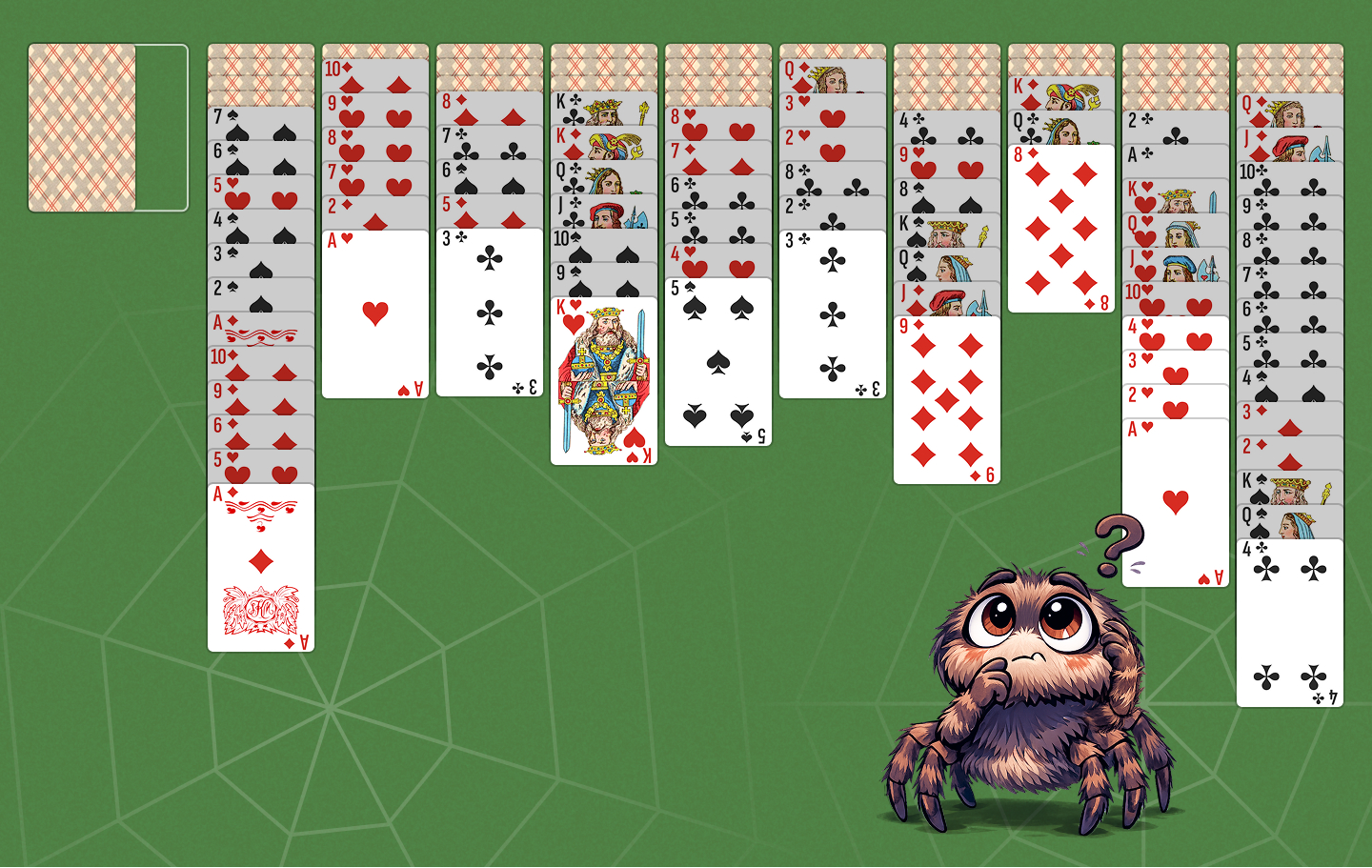
Winning at Spider Solitaire feels good, but winning efficiently feels even better. The difference between a casual player and a strategic master often comes down to move count. Learning how to reduce your moves transforms Spider Solitaire from a simple card game into an elegant puzzle that rewards planning and foresight.
Why Move Count Matters In Spider Solitaire
Move count serves as a reliable measure of your Spider Solitaire skill level. TheSolitaire tracks every move you make, giving you concrete data to measure improvement over time. Lower move counts correlate directly with better strategic decision-making and pattern recognition.
- Move count directly affects your score in Spider Solitaire games
- Efficient play increases your win rate by 15-30% based on player improvement over time
- Focusing on fewer moves trains you to evaluate multiple options before acting
- TheSolitaire’s move tracker lets you compare performance across different game sessions
Build In-Suit Sequences For A Strong Foundation
Building same-suit sequences is the most effective spider card game strategy for reducing moves. A complete same-suit sequence from King down to Ace can be moved in a single action, while a mixed-suit sequence requires breaking apart and rebuilding — often adding 10-15 moves to your total count.
Consider this practical example: You have a 7-6-5 of Hearts and need to move them to access a face-down card. If built in-suit, this takes one move. If mixed with Spades and Clubs, you’ll need to disassemble the sequence, use empty columns as temporary storage, then rebuild — potentially requiring five or more moves for the same outcome.
Same-suit building benefits:
- Allows entire sequences to be moved at once
- Creates cleaner tableaus with fewer obstructions
- Sets up complete sequences (K-A) for removal
- Reduces reorganization moves later in the game
Reveal Hidden Cards Early For Better Efficiency
Exposing face-down cards is one of the most powerful tips for spider solitaire to reduce your move count. Each revealed card provides new information that can completely change your optimal strategy. A single revealed card might show you a King that creates an empty column opportunity or an Ace that completes a sequence you’ve been building.
Priority matters here. A column with one face-down card is just one move away from being completely known, while a column with six face-down cards will take much longer to reveal. By targeting nearly-revealed columns first, you gain the most information with the least investment.
Card exposure priority:
- Columns with 1-2 hidden cards (highest priority)
- Columns with 3-5 hidden cards (medium priority)
- Columns with 6+ hidden cards (lowest priority)
Use Empty Columns For Better Move Control
Empty columns function as temporary storage that multiplies your movement options. Without an empty column, you can typically only move properly sequenced cards. With one empty column, you can move any single card. With two empty columns, you can reorganize entire stacks through a series of transfers.
Here’s a concrete scenario: You need to access a buried 8 of Hearts underneath a Jack of Spades, 10 of Diamonds, and 9 of Clubs. Without empty columns, this is impossible. With one empty column, you can move the Jack, then the 10, then the 9 individually — four moves total (three cards out, one card to the target). With two empty columns, you can move the Jack-10-9 sequence to the first empty column in one move, grab the 8, then reverse the process — three moves total.
| Strategy | Move Count Without Empty Column | Move Count With Empty Column |
| Building K-A sequence | 20+ individual moves | 5-8 moves using empty column buffer |
| Reorganizing mixed sequence | 15+ individual card moves | 3-4 moves using empty column |
| Extracting buried card | Often impossible | Possible with 5-10 moves |
Delay the Stockpile For Effective Strategy
Dealing from the stockpile adds ten new cards to your tableau — one to each column. This can bury the sequences you’ve carefully constructed and force you to rebuild them. A deal at the wrong moment might add 20-30 moves to your total as you reorganize the disrupted tableau.
The right time to deal is when you’ve exhausted all productive moves in the current layout. This means you’ve revealed all accessible face-down cards, built all possible same-suit sequences, and positioned your tableau to absorb the new cards with minimal disruption. Players who deal too early often find themselves stuck with unmovable cards and no clear path forward.
Before dealing from the stockpile:
- Exhaust all constructive moves in the current layout
- Try to complete at least one full suit if possible
- Position high-value in-suit sequences at column tops
- Arrange columns to absorb new cards with minimal disruption
Practical Steps To Lower Your Move Count
These actionable techniques apply to every game you play, whether you’re just learning the fundamentals or refining advanced strategies.
Prioritize Cards That Uncover New Paths
Not all moves are equal. A move that reveals a face-down card while building an in-suit sequence is worth more than a move that only accomplishes one of those goals. For instance, if you can move a 9 of Hearts onto a 10 of Hearts AND reveal a face-down card, you’ve gained twice the value of moving a 9 of Spades onto a 10 of Hearts without revealing anything new.
Consolidate In-Suit Runs Before The Deal
Before introducing new cards from the stockpile, spend a few moves organizing your same-suit sequences so they’re positioned at the tops of columns. When the new cards arrive, they’ll land on top of these organized sequences instead of disrupting mixed-suit arrangements. This preparation typically saves 5-10 moves after each deal.
Keep Track Of Potential Sequences
Experienced players mentally catalog which cards they need to complete sequences. If you’re building toward a King-through-Ace of Hearts, knowing you still need the 8, 5, and 3 helps you make better decisions about which columns to prioritize and which moves to save for later.
Seek a Second Empty Column
The jump from one empty column to two empty columns changes the game dramatically. With two empty columns, you can perform complex reorganizations that would be impossible otherwise. This is why experienced players will sometimes sacrifice 10-15 moves to create that second empty column — because it saves 30-40 moves later in the game.
When To Mix Suits and When To Avoid It
Pure in-suit building isn’t always possible. Sometimes you must make a mixed-suit move to reveal a critical card or create an empty column. The question is whether the long-term benefit outweighs the short-term cost.
A practical example: You have a face-down card that might be a King (creating an empty column opportunity) or an Ace (completing a sequence). Moving a 7 of Clubs onto an 8 of Hearts to reveal that card might be worth the mixed-suit penalty because of what you might find. However, mixing suits just to move cards around without revealing anything or creating an empty column typically adds moves without benefit.
Players tackling 4-suit Spider Solitaire need to be especially disciplined about mixed-suit moves, as the increased complexity makes reorganization significantly more expensive in terms of move count.
When mixed-suit building is acceptable:
- To uncover a critical face-down card
- To create an empty column
- To prepare for a complete sequence removal
- As a temporary measure with a clear conversion plan
Undo and Practice Tips For Spider Solitaire
TheSolitaire’s undo feature is a practice tool, not just an error correction. Use it to experiment with different approaches to the same position. You might discover that what looked like the obvious move actually cost you five more moves than an alternative you didn’t see initially.
Train With Undo For Optimal Outcomes
After completing a difficult section, use undo to return to the starting position and try a different sequence of moves. Compare the move counts. This comparison reveals which decision points had the biggest impact and trains your pattern recognition for future games.
Explore Multiple Moves Before You Commit
Before clicking, mentally trace out the next three to five moves. This brief pause often reveals inefficiencies. You might notice that moving the 9 of Hearts first, then the 8 of Spades requires three moves total, while reversing the order accomplishes the same goal in two moves.
How Do You Win Spider Solitaire Even When It Seems Hard
Difficult layouts test your problem-solving skills. Sometimes the “correct” move isn’t immediately obvious because all visible options look bad. In these situations, focus on incremental progress rather than perfect efficiency.
A game that seems unwinnable might have a narrow solution path that requires accepting a temporary increase in moves. You might need to add 10 moves now to set up a sequence clearance that saves 25 moves later. This type of strategic thinking separates intermediate players from advanced players.
Tackling difficult layouts:
- Focus on creating just one empty column first
- Look for hidden opportunities to consolidate suits
- Accept temporarily higher move counts for long-term reduction
- Use partial clearances to simplify the tableau
Apply Spider Card Game Strategy Online
Move reduction in Spider Solitaire comes from understanding the underlying principles, not memorizing specific sequences. The strategies outlined here—in-suit building, early card exposure, empty column management, and delayed stockpile usage — work together to create a framework for efficient play.
TheSolitaire offers the clean interface and move tracking you need to practice these techniques effectively. Try out these strategies in their Spider Solitaire game and track your progress as your average move count decreases over time. Most players see measurable improvement within 10-20 games of focused practice.
FAQs About Reducing Moves In Spider Solitaire

What is the average number of moves needed to win Spider Solitaire?
The average move count varies significantly by difficulty level. In 1-suit Spider Solitaire, skilled players typically complete games in 80-120 moves, while beginners might use 150-200 moves. For 2-suit games, expect 120-180 moves for experienced players. The challenging 4-suit version usually requires 150-250 moves even for advanced players. Your move count will naturally decrease as you internalize the strategies outlined in this guide and develop better pattern recognition.
Does reducing moves in Spider Solitaire increase winning chances?
Absolutely. The skills that reduce move count—strategic planning, same-suit building, and delayed stockpile usage—are the same skills that increase win rates. Players who focus on move efficiency typically see their win rate improve by 15-30% because they’re making better decisions at critical moments. Lower move counts indicate you’re revealing cards efficiently, managing empty columns effectively, and avoiding unnecessary reorganization. These habits directly translate to more completed games.
How can I practice reducing moves in Spider Solitaire?
Start by playing on TheSolitaire and tracking your move count across multiple games. Focus on one technique at a time—spend five games prioritizing in-suit sequences, then five games focusing on early card exposure. Use the undo feature to experiment with different move sequences and compare the results. Set specific goals like “reduce my average by 10 moves this week” rather than trying to perfect everything at once. Recording your move counts in a simple spreadsheet helps you visualize improvement over time.
Are there different strategies for 1-suit versus 4-suit Spider Solitaire?
The core principles remain the same, but their application differs. In 1-suit Spider Solitaire, you can build in-suit sequences almost constantly, making move reduction straightforward. In 4-suit games, you’ll need to accept more mixed-suit building as a temporary measure, but the penalty for mixing suits becomes much steeper. The 4-suit version requires more careful planning before each move and greater discipline about when to deal from the stockpile. Empty columns become even more valuable in 4-suit games because reorganization is more complex.
Why do my move counts spike after dealing from the stockpile?
Dealing from the stockpile adds ten new cards that can bury your carefully constructed sequences. If you deal before exhausting productive moves, you’re essentially creating problems you’ll need to solve with additional moves. The spike happens because you must now reorganize disrupted sequences, work around blocked cards, and rebuild what you had before—often requiring 20-30 extra moves. This is why delaying the deal until absolutely necessary is one of the most effective move-reduction strategies. Proper preparation before dealing—consolidating in-suit runs and positioning sequences strategically—minimizes this spike.