
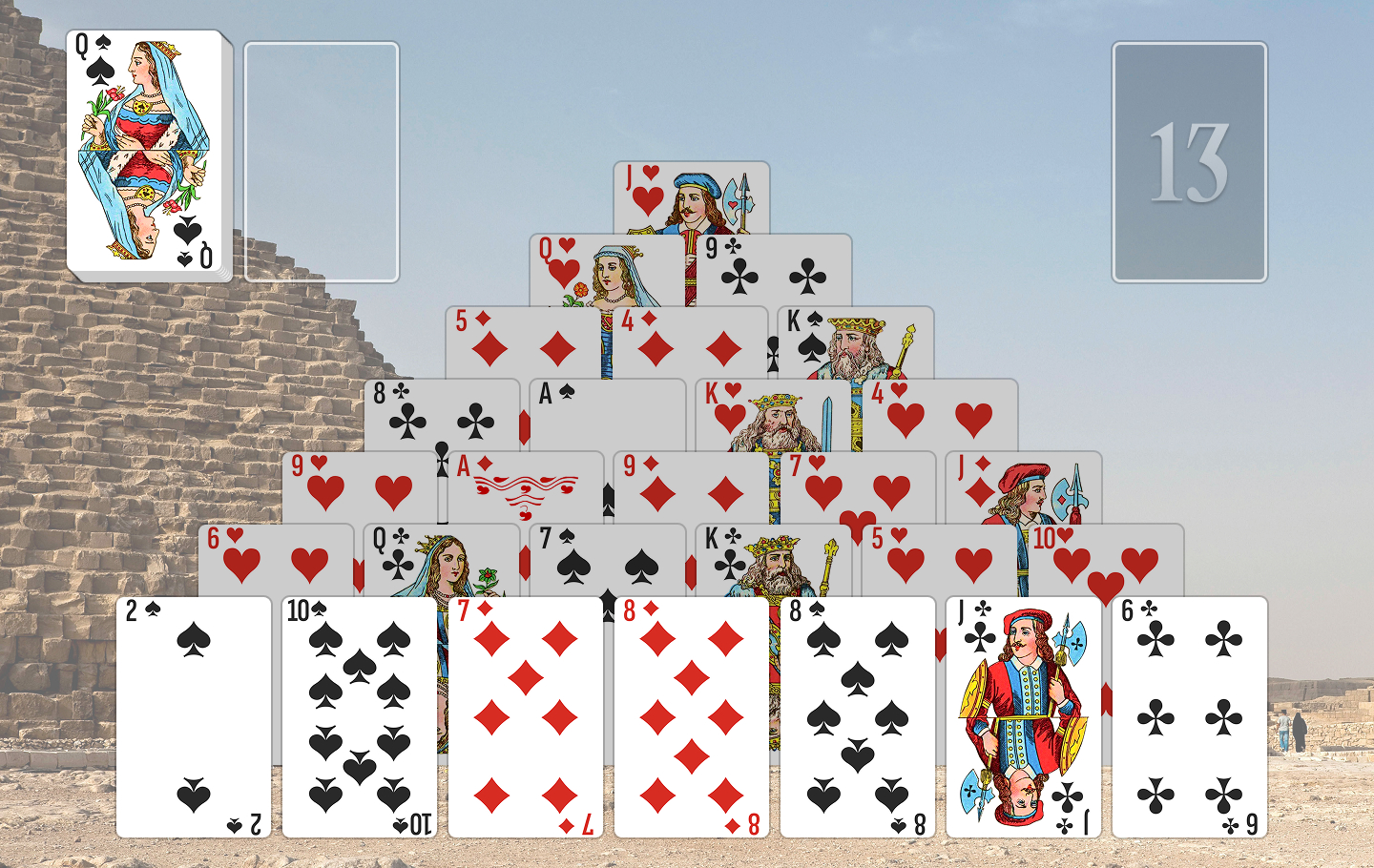
Pyramid Solitaire offers a refreshing twist on traditional card games, challenging players to think strategically about number combinations rather than suit sequences. If you’ve mastered other solitaire variations and want something different, or if you’re new to solitaire games entirely, learning Pyramid Solitaire opens up an engaging world of mathematical pairing and strategic planning. This guide walks you through everything you need to know to start playing and winning.
What Is Pyramid Solitaire?
Pyramid Solitaire is a popular variation of solitaire card games, beloved for its unique pyramid-shaped layout and engaging gameplay. Unlike classic solitaire games such as Klondike or FreeCell, Pyramid Solitaire challenges players to remove pairs of cards that sum to 13, making it a distinct and strategic patience game. It is also commonly referred to as “pyramid solitare,” “solitaire pyramid,” and “pyramid solitaire classic.”
The game has a rich history as a favorite among card enthusiasts, dating back to the 20th century. Its appeal lies in its simple rules and the satisfying challenge of dismantling the pyramid. Pyramid Solitaire is played with a standard 52-card deck and fits into the broader family of solitaire games by offering a fresh twist: instead of building sequences, players focus on matching pairs.
In Pyramid Solitaire, the objective is to clear the pyramid by removing pairs of exposed cards that add up to 13. This core mechanic sets it apart from other solitaire games and is the key to mastering the game. The combination of mathematical thinking and strategic card removal creates a puzzle-like experience that feels different with every deal.
Key points:
- Focuses on removing pairs that sum to 13 rather than building suit sequences
- Uses a standard 52-card deck arranged in a distinctive pyramid shape
- Balances mathematical calculations with forward-thinking strategy
- Typically takes 5-15 minutes per game, perfect for quick mental breaks
How To Set Up The Pyramid
Setting up Pyramid Solitaire correctly is the foundation for smooth gameplay. The setup takes less than a minute once you understand the pattern.
1. Deal Cards
Begin by shuffling a standard 52-card deck thoroughly. Deal cards face-up in a triangular pattern to form the pyramid. Each card should overlap the cards above it slightly so that all cards remain visible throughout the game. The pyramid shape is what gives the game its name and creates the strategic challenge of accessing buried cards.
2. Form The Pyramid
Arrange the cards in 7 rows following this specific pattern:
- Row 1 (top): 1 card
- Row 2: 2 cards, each partially covering the card above
- Row 3: 3 cards
- Row 4: 4 cards
- Row 5: 5 cards
- Row 6: 6 cards
- Row 7 (bottom): 7 cards
This uses 28 cards in total. A card is only considered “exposed” and playable when no other cards cover any part of it. For example, in the initial setup, only the seven cards in the bottom row are exposed and available for pairing.
3. Place Remaining Cards In Stock
The remaining 24 cards form the “stock” or “draw pile.” Place these cards face-down beside the pyramid where you can easily reach them during play. As you draw from this pile, you’ll flip cards one at a time into a face-up waste pile. These waste pile cards become available for pairing with exposed pyramid cards or, in some variations, with each other.
Card Values and the Sum Of 13
Understanding card values and the core mechanic of summing to 13 is the foundation for playing Pyramid Solitaire. Every move you make revolves around this simple but strategic concept.
Each card has a specific value:
- Ace = 1
- Cards 2 through 10 = face value
- Jack = 11
- Queen = 12
- King = 13
Kings are unique because they already equal 13 and can be removed individually from the pyramid or stock as soon as they are exposed. This makes Kings particularly valuable for opening up new areas of the pyramid. All other cards must be paired with another card so that their combined value totals exactly 13. For example, a 5 can be paired with an 8, a 4 with a 9, a 3 with a 10, a 2 with a Jack, and an Ace with a Queen.
Only exposed cards in the pyramid or the top card of the waste pile can be used to make pairs. This restriction is what creates the strategic depth — you must think carefully about which pairs to remove first, as your choices determine which cards become exposed next.
Pairing combinations that sum to 13:
| Card 1 | Card 2 |
| King | (none needed) |
| Queen | Ace |
| Jack | 2 |
| 10 | 3 |
| 9 | 4 |
| 8 | 5 |
| 7 | 6 |
How To Play From Start To Finish
Once the pyramid is set up and you understand the card values, you’re ready to work through a complete game. Each game presents a fresh puzzle to solve.
1. Scan For Available Pairs
Before drawing any cards from the stock, scan the exposed cards in the bottom row of the pyramid for any pairs that sum to 13. Also look for any Kings that can be removed immediately. This initial assessment helps you plan your opening moves and identify which areas of the pyramid you can start breaking down.
2. Remove Initial Pairs
Remove any pairs you found in the exposed cards. When you remove a pair, check which new cards become exposed. A card becomes exposed when both cards that were covering it are removed. This cascading effect is where much of the strategy comes into play — some pairs expose more valuable cards than others.
3. Draw From Stock
When you cannot make any more pairs with the currently exposed pyramid cards, draw one card from the stock pile. Place it face-up in the waste pile. You can now pair this waste card with any exposed pyramid card, or if it’s a King, remove it immediately.
4. Continue The Process
Keep alternating between removing pairs from the pyramid and drawing new cards from the stock. As you break down the pyramid from bottom to top, plan your moves to expose cards strategically. The game ends when you’ve removed all 52 cards (a win) or when you’ve exhausted the stock and can no longer make any valid pairs (a loss).
Gameplay flow:
- Scan exposed pyramid cards for immediate pairs
- Remove pairs strategically to expose cards that help future moves
- Draw from stock only when no pyramid pairs are available
- Watch for Kings to remove individually at any opportunity
Tips and Strategies To Win At Pyramid Solitaire
Pyramid Solitaire has a win rate of approximately 30-40% depending on the rules variation you play. These strategies can help you maximize your chances of clearing the pyramid.
1. Remove Kings Immediately
Kings should be removed the moment they become exposed or appear in the waste pile. Because they don’t require a partner card, their removal is essentially “free” and always opens up more options. Leaving a King in place serves no strategic purpose and only limits your ability to expose other cards.
2. Think Two Moves Ahead
Before removing any pair, look at what cards will become exposed. Sometimes you’ll have a choice between two pairs that both sum to 13. Choose the pair that exposes cards more likely to create additional matches. For example, if removing one pair exposes a King while another pair exposes two mid-value cards, removing the pair that reveals the King is usually the better move.
3. Preserve Cards That Have Multiple Partners
When possible, keep cards in the pyramid that can pair with multiple values. For example, a 6 in the pyramid can pair with any 7 that appears in the waste pile, but a Queen can only pair with an Ace. If you have a choice between removing a 6 or a Queen from the pyramid, consider saving the 6 for later since it offers more flexibility.
4. Avoid Creating Dead Zones
Try not to leave a single card isolated where both of its covering cards are still in place. Once you’ve removed one card covering another, try to remove its partner as well so the card beneath becomes exposed. Otherwise, you create areas of the pyramid that become difficult to access later in the game.
Common mistakes beginners make:
- Removing the first pair they see without considering what becomes exposed
- Not removing Kings immediately when they appear
- Focusing on waste pile cards while ignoring better pairs in the pyramid
- Not recognizing when a card in the pyramid has limited pairing options
Common Variations To Try
After mastering the standard rules, these variations add new challenges and keep the game fresh. Each variation changes the difficulty level and strategic considerations.
Relaxed Pyramid allows you to pair the top waste pile card with cards you draw from stock, not just with pyramid cards. This makes the game more forgiving and increases your win rate by roughly 10-15%. It’s an excellent variation for beginners still learning the basic strategies.
Giza uses two or more standard decks and builds a larger pyramid structure. This creates a longer game with more cards to manage. The increased pyramid size means you’ll need to plan even further ahead, as early decisions have more cascading effects.
Three-Card Draw mimics Klondike’s draw method, where you flip three cards at a time from stock but can only use the top card. This increases difficulty because you have less control over which stock cards become available when. It adds an extra layer of luck to the game.
Timed Challenge adds a countdown timer, typically 5-10 minutes, to complete the pyramid. This variation tests your ability to spot pairs quickly and make decisions under pressure. The time constraint often forces you to abandon perfect strategy in favor of speed.
For players seeking extra challenge, Double Pyramid Solitaire presents two pyramids side by side that share a single stock pile. You must clear both pyramids, which requires you to balance your attention between two separate card layouts and make strategic choices about which pyramid to work on at different points in the game.
Why People Love Free Pyramid Solitaire
Pyramid Solitaire has remained popular for decades because it strikes an ideal balance between accessibility and mental challenge. The rules take only minutes to learn, but the strategy can take months to master.
The game provides genuine cognitive benefits through its focus on mathematical reasoning and pattern recognition. Each game forces you to calculate sums quickly, remember which cards have been played, and visualize how removing certain pairs will affect future options. These mental exercises help maintain mental sharpness without feeling like work.
The short game length is another major appeal. Most games finish within 5-15 minutes, making Pyramid Solitaire perfect for fitting into brief breaks throughout the day. You can complete a full game while waiting for a meeting, during a lunch break, or while unwinding in the evening.
The mathematical certainty also provides satisfaction — you always know exactly what you’re looking for (pairs that sum to 13), which creates clear goals and measurable progress. When you successfully clear the pyramid, you’ve solved a genuine puzzle through logical thinking.
Key benefits players experience:
- Improves quick mental math and pattern recognition skills
- Provides a focused mental break without external distractions
- Offers consistent challenge without overwhelming complexity
- Creates a sense of accomplishment when puzzles are solved
Play Pyramid Solitaire Anytime
Ready to test these strategies yourself? TheSolitaire.com offers a free, distraction-free way to play Pyramid Solitaire online with no downloads or registration required. The site features a clean interface, undo functionality when you want to reconsider a move, and hint features if you get stuck. Start playing today and experience why Pyramid Solitaire has been a favorite for generations.
Frequently Asked Questions
Can You Use An Undo Button In Pyramid Solitaire?
Yes, when playing Pyramid Solitaire on TheSolitaire.com, the undo feature lets you reverse your last move if you realize it exposed the wrong cards or created a difficult position. This feature is particularly helpful when learning the game and understanding how different pairs affect the pyramid structure.
What Is The Success Rate For Winning Pyramid Solitaire?
Pyramid Solitaire typically has a win rate between 30-40%, though this varies based on which variation you play and how strictly the rules are enforced. The standard version is moderately challenging, while variations like Relaxed Pyramid increase your winning chances and variations like Three-Card Draw make wins more difficult. With practice and strategic play, experienced players can win closer to the upper end of this range.
How Long Does A Typical Pyramid Solitaire Game Take?
Most Pyramid Solitaire games finish within 5-15 minutes. Games where you clear the pyramid early tend to be shorter, while games where you cycle through the entire stock pile multiple times take longer. This quick gameplay makes it ideal for short breaks or when you want a brief mental challenge without a significant time commitment.
Can You Play Pyramid Solitaire With A Regular Deck Of Cards?
Yes, Pyramid Solitaire only requires a standard 52-card deck with no jokers. Simply deal 28 cards in the pyramid pattern (7 rows with increasing cards from top to bottom), keep the remaining 24 cards as your stock pile, and follow the basic rules of removing pairs that sum to 13. The physical version offers the same strategic challenges as online versions, though online play includes helpful features like automatic pairing and move suggestions.