
FreeCell stands apart from other solitaire variants because nearly every deal can be won with the right strategy. Unlike games that rely heavily on luck, FreeCell rewards careful planning, thoughtful analysis, and strategic execution. This guide will help you develop the skills needed to approach even the most challenging deals with confidence, drawing from patterns observed across thousands of games.
Understanding FreeCell Game Rules
FreeCell uses a standard 52-card deck arranged in eight tableau columns. The goal is to build four foundation piles by suit from Ace to King. What makes FreeCell unique is the four “free cells” in the upper left corner — temporary holding spaces for individual cards. Unlike other solitaire games where luck plays a significant role, FreeCell is almost entirely skill-based. Most mathematical analyses indicate that over 99% of the original 32,000 Microsoft deals are solvable with perfect play.
When learning how to play FreeCell, you’ll quickly discover that it’s not about making the first move you see. It’s about understanding the entire tableau before you touch a single card. The free cells give you tactical flexibility, but they’re not unlimited storage. Each decision matters, and the game rewards players who think several moves ahead. You’ll know you’re improving when you start seeing problems before they arise rather than after you’re stuck.
Tableau Analysis Before Your First Move
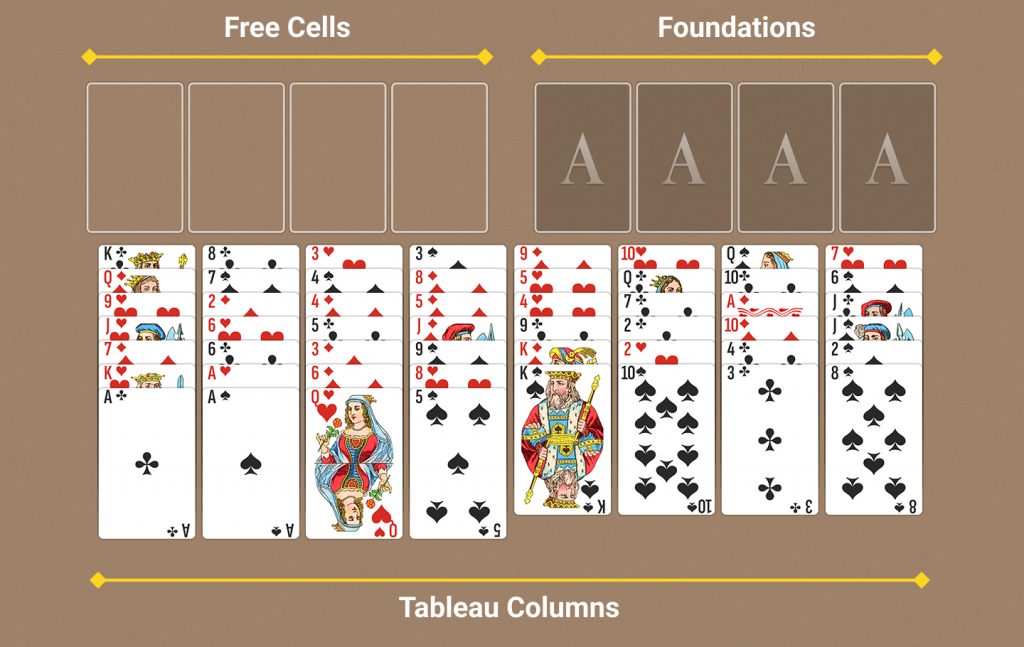
1. Scan All Columns And Free Cells
Before making your first move, take at least 15-30 seconds to survey the entire layout. Look for aces and twos, identify cards that are blocking progress, and spot potential sequences you can build. This initial assessment shapes your entire strategy and often reveals which columns will be easiest to clear.
Check these key elements:
- Card Distribution: How evenly cards are spread across suits—imbalanced distributions often signal which suits will cause bottlenecks
- Blocked Low Cards: Identify aces and twos trapped under higher cards, particularly when they’re buried under several cards of the same color
- Potential Empty Columns: Columns that could be cleared with minimal moves—typically those with four or fewer cards that flow naturally
2. Identify Potential Blockers
Some card arrangements create natural bottlenecks. A high card sitting on top of an ace creates problems. Kings buried in the middle of columns limit your options. When you spot these blocking patterns early, you can plan your moves to address them before they become critical issues. For example, if you see a King covering a two, that column should become a priority target for restructuring. In freecell difficult games, recognizing these patterns is the difference between winning and getting stuck halfway through.
Aces and Twos As Your Foundation Keys
1. Locate Low Cards Early
Finding and freeing your aces and twos should be among your first priorities. These cards are the foundation of your victory, quite literally. Scan each column to see where these low cards are hiding and plan the sequence of moves needed to liberate them. When an ace is buried under five or six cards, you may need to create an empty column just to access it — a worthwhile investment.
2. Free Them Up Without Cluttering
Move aces to the foundation piles immediately — they serve no purpose in the tableau and only take up valuable space. Twos are slightly different. While you’ll usually move them to foundations right away, occasionally you might keep a two in the tableau temporarily if it’s helping hold a sequence together that you’re not ready to break. This balance between clearing foundations and maintaining tableau flexibility is central to effective freecell strategy.
How To Keep The Free Cells Clear
1. Reserve Cells For Emergencies
Empty free cells are your lifeline for complex maneuvers. The more free cells you have available, the longer the sequences you can move. This mathematical relationship is fundamental to the game and determines what moves are even possible:
| Empty Free Cells | Max Sequence Length That Can Be Moved |
| 4 | 5 cards |
| 3 | 4 cards |
| 2 | 3 cards |
| 1 | 2 cards |
| 0 | 1 card |
This assumes you have no empty columns. With one empty column, these numbers effectively double. With all four free cells and one empty column available, you can move sequences of up to 10 cards — a game-changing capability.
2. Move Cards Out Promptly
Cards in free cells should be temporary residents, not permanent fixtures. If a card sits in a free cell for more than 10-15 moves, you’ve likely made a strategic error. Look for opportunities to move these cards back to the tableau or up to the foundations. A common scenario: you’ve placed a seven of hearts in a free cell, but now you need that cell for a King. Before placing the King, check if the eight of spades or eight of clubs is exposed — the seven can probably go there. If you find yourself stuck with all four cells full, freecell with hints can help you identify moves that free up your cells.
Empty Columns For Added Flexibility
1. Plan Moves To Clear A Column
Empty columns are even more valuable than free cells. They allow you to temporarily store entire sequences, dramatically increasing your tactical options. Creating an empty column early in the game often determines whether you’ll win or lose. The first empty column is typically the hardest to create and the most valuable.
Common techniques include:
- Cascade Technique: Moving cards in sequence to clear a column by building on other columns
- Temporary Storage: Using free cells strategically to rearrange cards — place blockers in cells while you clear underneath them
- Target Selection: Choosing the optimal column to clear — usually the shortest column or one that contains mostly sequential cards
2. Leverage Open Columns To Shift Sequences
Once you have an empty column, you can move longer sequences around the tableau. Each empty column effectively multiplies your movement capacity through the formula: (number of empty columns + 1) × 2^(number of empty free cells). This flexibility is necessary for accessing blocked cards and reorganizing the tableau. With two empty columns and two empty free cells, you can move sequences of 12 cards — enough to solve most endgame situations. Mastering this aspect of strategy for freecell separates beginners from advanced players.
Long Sequences And Strategic Splits
1. Stack With Purpose
Build sequences deliberately. A well-constructed descending run of alternating colors creates opportunities for moving multiple cards at once. However, don’t build sequences just because you can. Each stack should serve a purpose — freeing a low card, creating space, or preparing for a freecell solution that advances your game. A common mistake is building a long sequence that traps a card you’ll need later. For instance, building Queen-Jack-10-9-8 might look productive, but if the nine is covering the only exposed ace, you’ve just created a problem.
2. Break Up Large Runs Carefully
Sometimes you need to split a sequence to access a card buried beneath it. This requires careful thought. Breaking up a useful sequence prematurely can cost you the game. Before breaking a sequence, trace through exactly where each card will go — have specific destinations planned, not just vague ideas. In tough freecell games, knowing when to split sequences and when to preserve them often determines the outcome. A sequence of seven or more cards should rarely be broken unless you’re certain you can rebuild it or no longer need it.
How To Plan Moves Ahead For Hard FreeCell Games
1. Visualize Multiple Steps
The best FreeCell players think three to five moves ahead. Before touching a card, trace the sequence of moves in your mind. Will this move give you access to a blocked ace? Does it create an empty column? Will you have the free cells available when you need them? This mental mapping is needed for hard freecell deals that require precision. Start by planning just two moves ahead, then gradually extend your planning horizon as you improve.
2. Adapt For Difficult Games
Some deals are notoriously challenging. Game #11982, for example, is considered one of the few unsolvable deals in the original Microsoft set. When you encounter freecell hard games — typically those where most low cards are buried deep or where suits are extremely imbalanced—slow down and increase your planning depth. These difficult arrangements require patience and the willingness to undo multiple moves if you hit a dead end. Some deals might take 200+ moves to solve, compared to 80-100 for average games. You can test your skills with Challenge FreeCell for progressively difficult deals that help you develop advanced techniques.
Undo Strategies For Solution And Recovery
1. Correct Early Missteps
The undo feature isn’t cheating — it’s a learning tool. When you realize a move has led you down a problematic path, undo it and try a different approach. The key is understanding why the move failed. Did it fill a needed free cell? Did it block access to a card? Did it break up a useful sequence? Each mistake teaches you something about which moves work and which create problems. This trial-and-error process, when done thoughtfully, accelerates your path to finding the freecell solution.
2. Learn From Each Undo
Pay attention to why certain approaches fail. Did you fill your free cells too quickly? Did you block a key card by moving something to the foundation prematurely? Did you clear the wrong column first? Keep a mental note of these decision points. Many players find that the same types of mistakes repeat — moving cards to foundations too aggressively is probably the most common error. After a few dozen games, you’ll start recognizing problem patterns before you make the mistake.
Foundation Pile Balance For Smooth Progress
1. Advance Cards Evenly
Building all four foundation piles at roughly the same pace prevents problems. If one suit races ahead while others lag behind, you might find that you’ve blocked cards needed in the tableau. Aim to keep your foundation piles within a card or two of each other. A good guideline: if one foundation pile has reached seven while another is still at three, you’ve probably moved cards too aggressively.
2. Avoid Blocking Key Cards
This is one of the most subtle aspects of freecell game rules: just because you can move a card to the foundation doesn’t mean you should. Sometimes a four or five needs to stay in the tableau temporarily because you’ll need it to build sequences that free other cards. A practical rule: don’t move a card to the foundation if it might be needed to place an opposite-color card that’s currently blocking progress. For example, if the five of hearts could help you place the six of spades, which is covering an ace, keep that five in play. Moving it too soon can create an unwinnable position.
Tips For Easy FreeCell Games And Deals
1. Recognize Different Challenges
Not all FreeCell games are equally difficult. Some deals, like game #1941, are notably straightforward and serve as excellent practice for beginners. In freecell easy games, you’ll often find that low cards are more accessible — perhaps three or four aces are already exposed or only one card deep. Fewer cards are deeply buried in problematic positions, and suit distribution tends to be more balanced.
2. Adjust Strategy For Lower Difficulty
When you recognize you’re playing one of the easiest freecell deals, you can afford to be more aggressive with foundation building. You won’t need to preserve as many cards in the tableau, and you can use your free cells more liberally since the deal is forgiving. In easy games, you might move fours and fives to foundations immediately, whereas in difficult games, you’d hold them back. The margin for error is larger, making these deals perfect for practicing new techniques without the frustration of difficult games.
Where To Play and Your Next Steps
TheSolitaire offers a clean, distraction-free interface that helps you focus on strategy rather than flashy graphics or unnecessary features. The intuitive layout makes it easy to plan your moves, while the undo and hint features support your learning without holding your hand. Every game at TheSolitaire is an opportunity to refine your strategic thinking and tackle increasingly complex challenges. The platform’s keyboard shortcuts also speed up play once you’ve learned the strategies, letting you focus on decision-making rather than clicking.
Regular practice is the key to improvement. Each game teaches you something new about pattern recognition, move planning, and tactical decision-making. Most players see significant improvement after 30-50 games, with win rates climbing from 40-50% to 70-80% as pattern recognition develops. Start playing FreeCell and put these strategies into practice today.
Frequently Asked Questions About FreeCell Strategy
Are There Any FreeCell Deals That Cannot Be Solved?
While mathematical analysis shows that the vast majority of FreeCell deals are solvable, a small number of the original Microsoft deals (like #11982) are considered impossible to solve with standard rules. Out of the original 32,000 numbered games, only a handful have been proven unsolvable. However, the exact number remains debated among FreeCell enthusiasts, and new impossible deals are occasionally discovered.
How Many Free Cells Should I Keep Available During Gameplay?
Aim to keep at least two free cells open whenever possible, as this allows you to move sequences of three cards and maintains flexibility for complex maneuvers during critical points in the game. If you find all four cells full, that’s usually a signal that you’ve made a strategic error several moves back. The best players rarely have more than two cells occupied at once.
Does Practicing FreeCell Strategy Improve Performance In Other Solitaire Games?
Yes, the planning, sequencing, and spatial reasoning skills developed through FreeCell directly transfer to other solitaire variants like Klondike and Spider, improving your overall card game strategic thinking. The habit of analyzing the full layout before moving and planning several steps ahead applies to virtually all patience games.
What Is The Most Common Mistake Beginners Make In FreeCell?
The most common beginner mistake is moving cards to the foundation piles too quickly without considering how those cards might be needed in the tableau to access other cards, often leading to unwinnable positions. Specifically, moving mid-range cards (fours through sevens) to foundations prematurely causes most losses. Wait until you’re certain you won’t need these cards to build sequences.
How Long Does It Typically Take To Master FreeCell Strategy?
Most players develop solid FreeCell strategy after playing about 50-100 games, with mastery of advanced techniques for difficult deals typically requiring 200+ games and deliberate study of strategic principles. Your win rate is a good indicator — beginners might win 30-40% of games, intermediate players 60-70%, and advanced players can achieve 85-95% win rates on random deals. Perfect play theoretically approaches 99%, but even experienced players make occasional strategic errors.